
1200 GSM Car Drying Towels: Wholesale Specification Guide
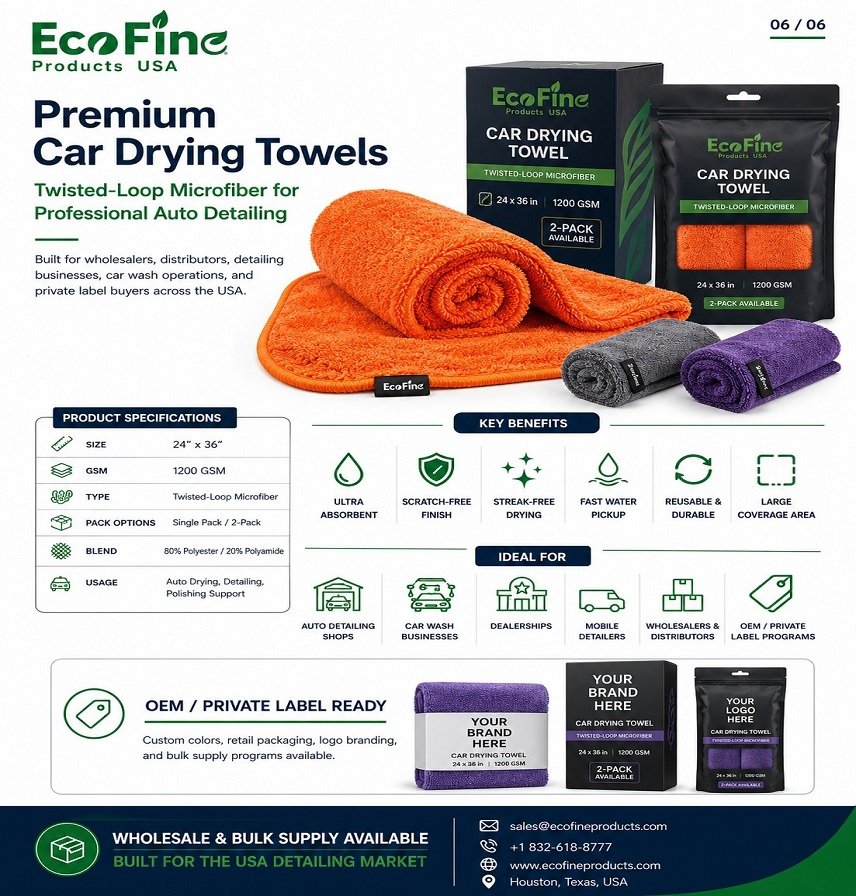
1200 GSM car drying towels should be purchased as an identified configuration within a commercial exterior-drying process. The fabric-weight number alone does not define dimensions, blend, edge finish or the quantity supplied. EcoFine’s 1200 GSM drying-towel listing describes a double-sided twisted-loop program with several ordering options. This guide focuses on confirming the selected specification and accepting repeat stock without dated bulk-price tables or an assumption that every variation is held ready to ship.
Identify the Selected Product Configuration
Start with the exact item reference and the characteristics proposed for the order. EcoFine’s reviewed listing features a 24×36-inch format and also describes metric size options with approximate U.S. equivalents. Confirm the chosen finished dimensions rather than treating the featured format as the only possibility. Keep the sample identity with the requirement. The order still needs to specify which configuration the buyer intends to receive.
Separate Fabric Weight From Performance
1200 GSM means 1200 grams of fabric mass per square meter. It is not a guaranteed absorption capacity or drying-speed rating. Assess it alongside dimensions, double-sided twisted-loop construction, the selected blend and edge finish. A towel described by the same GSM may differ in other relevant details. Keep the distinction clear in internal records and customer descriptions, so purchasing decisions remain connected to the complete item rather than an unsupported promise attached to the density number.
Confirm Blend and Edge Choices
The reviewed program includes 80/20 or 70/30 polyester/polyamide blend options and several edge finishes, subject to the selected order. Ask which applies to the actual sample and proposed supply. Do not assume that every combination is stocked or interchangeable. Record the agreed size, blend, edge and color with the item reference. If a supplier proposes an alternative, review the working difference before accepting it rather than allowing a familiar 1200 GSM title to conceal a changed configuration.
Approve the Towel Through Representative Use
Have regular staff evaluate the identified sample under the approved wash and exterior-drying method. Record control, access, remaining moisture, repeated attention and towel changes. Compare alternatives on equivalent work and keep relevant vehicle and preparation details with the findings. A short demonstration on an easy panel does not represent the whole operating task. Retain the acceptance limits, giving purchasing a practical reason for the selected configuration without declaring the towel universally scratch-free or suitable for every vehicle finish.
Include the Care and Return Process
Obtain the supplied care label and confirm cleaning, drying and treatment requirements. Reassess the maintained sample as well as new stock. Inspect fabric and edges before return to service. Keep used towels separate from ready replacements under the program’s handling method. A reusable description does not establish an invented wash-cycle lifespan. Review actual use and return timing so the stock quantity reflects the process that makes suitable towels available when the drying stage needs them.
Define Quantity Units and Allocations
State whether the request counts individual towels, packs or cartons and confirm the contents of each unit. Keep destination and color allocations explicit. Identify any separate branding or packaging requirement rather than inferring it from a photograph. A previous packing arrangement should not be treated as permanent without confirmation. Clear units give receiving and operating teams the same count, preventing a bulk request planned as packs from being interpreted elsewhere as the number of individual towels available.
Review the Proposed Supply Arrangement
Ask the supplier to confirm the actual configuration, selected availability and requested delivery arrangements. Keep open specification questions visible until resolved. If custom branding is needed, define approval separately from the working textile. A packaging update should not silently authorize a different fabric or count. Record the agreed version so another buyer can understand what was approved without reconstructing an informal discussion or assuming every option in the product program applies to the order.
Check the Delivery Against the Accepted Item
Provide receiving with the current specification, sample reference, quantity units and allocation record. Review representative products according to the organization’s procedure and keep discrepancies identifiable until resolved. Ask EcoFine to confirm outstanding order details using the agreed configuration. Receiving should compare the supplied towel with the item already assessed by operations, not invent a performance judgment from fabric density or appearance when the cartons arrive.
Preserve a Repeatable Order Record
Save accepted dimensions, construction, blend, edges, care, pack units and sample findings with the supplier reference. Review substitutions before stock is distributed and tell operations when an accepted change affects handling or maintenance. Revisit the requirement when the vehicle mix or method changes. A clear record lets another buyer repeat the approved 1200 GSM configuration without relying on a dated price table or an assumption that the title establishes every working characteristic.
Planning and Approval Checklist
| Check | Requirement |
|---|---|
| Task | Record the approved assignment |
| Item | Confirm the complete configuration |
| Availability | Count usable and unavailable stock separately |
| Review | Retain local findings and accepted changes |
Frequently Asked Questions
Does 1200 GSM define the complete item?
No. Confirm dimensions, construction, blend, edges, colors, care and actual order contents for the selected configuration.
Which reviewed construction is offered?
EcoFine’s reviewed 1200 GSM program describes double-sided twisted-loop options. Confirm the exact size, blend, edge and selected availability before approval.
Why approve a sample before allocation?
Assess representative work and permitted care with normal operators. Keep acceptance tied to the exact configuration tested.
How should quantities be expressed?
State towels, packs or cartons and confirm their contents. Keep destination and color allocations consistent with those units.
Does a product image establish order contents?
No. Confirm the actual pack, selected configuration and any separate packaging or accessory requirements with the supplier.
What should receiving staff compare?
Compare identification, quantities and representative item details with the current approved record before distributing stock.
How should substitutions be handled?
Review changes to size, fabric, blend, edges or care against sample findings and notify operations before accepted alternatives enter use.
How should repeat quantities be planned?
Count ready stock, use, care and reserve separately. Review observed demand, losses, withdrawals and actual return timing.