
1200 vs 1400 vs 1600 GSM: Car Drying Towel Comparison
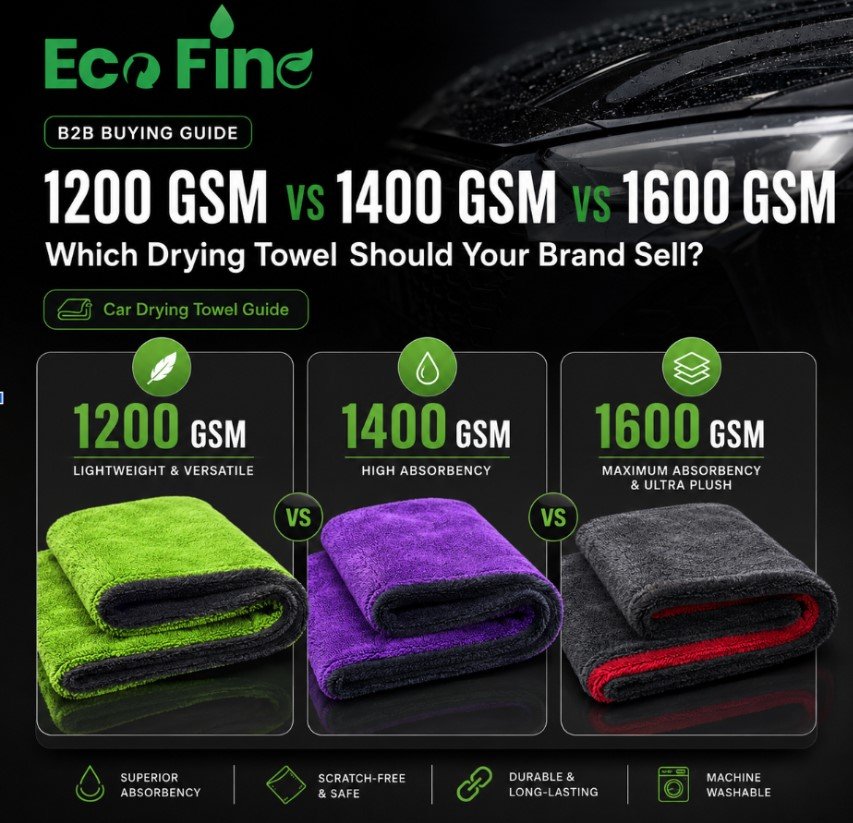
A 1200 vs 1400 vs 1600 GSM comparison describes three fabric-weight specifications, not three guaranteed levels of drying performance. Commercial buyers need to compare the complete towel and its intended role. EcoFine lists 1200 GSM, 1400 GSM and 1600 GSM double-sided twisted-loop drying-towel programs. This guide explains how to compare their density, dimensions and handling without assuming the heaviest option must lead every commercial product range.
Read the Numbers as Fabric Mass
GSM means grams of fabric mass per square meter. At equal fabric area, 1400 GSM describes more material mass than 1200 GSM, while 1600 GSM describes more than either. It does not state the volume of water a finished towel will absorb. Keep the distinction between a measurable fabric characteristic and an observed operating result. A density comparison is useful when the rest of the configuration is identified, rather than when it stands in for every feature of the product.
Hold Dimensions Constant Before Comparing Density
A larger towel and a denser towel change different parts of the comparison. Record finished length and width for every sample. Two towels with different areas can have different total fabric mass even when their GSM ranking suggests another order. Keep nominal sizes and approximate unit equivalents distinguishable from confirmed measurements. A buyer should be able to identify whether the sample decision concerns density, coverage or both, rather than attributing every handling difference to the number in the product title.
Confirm Construction, Blend and Edges
EcoFine’s reviewed programs describe double-sided twisted-loop construction with several size, blend and edge options. Confirm the exact item proposed rather than assuming that every listed option applies to every order. Ask which composition and edge finish were used in the sample and retain that information with its reference. A similar color or premium description does not establish an equivalent configuration.
Assess Control During the Assignment
Have regular staff evaluate the identified towels through the approved exterior-drying method on representative vehicles. Observe unfolding, folding, repositioning and access, including the towel’s working condition rather than only its dry feel. A broad or dense format may be useful for one task while another configuration is easier elsewhere. Record the operator and vehicle conditions with the sample.
Use the Same Result Check
Compare remaining moisture, missed areas, repeated attention and towel changes under the program’s normal inspection conditions. Keep the approved preparation and drying method comparable. Review residue, loading, technique and towel condition when results vary. A local trial can support a selected configuration but cannot establish a guaranteed drying rate, scratch-free outcome or universal absorption ratio. Retain what was actually observed instead of replacing the comparison with a simple good, better and best product ladder.
Include Care in the Choice
Obtain the care label for each selected configuration and confirm the available cleaning and drying process. Reassess maintained samples as well as new items. Inspect fabric and edges and record any relevant handling change after permitted care. Count items awaiting maintenance separately from ready reserve. A heavier specification does not remove the need for stock return or establish a fixed service life.
Build a Range Around Distinct Requirements
If several configurations are being considered, identify the actual task or customer requirement each would serve. Do not create a tier solely because the GSM number is higher. A range may need different dimensions, handling characteristics or packaging, with each choice supported by its own assessment. Keep the descriptions accurate to the confirmed product. An observed local preference should not be presented as a statewide demand trend or proof that every commercial buyer should select the same density.
Order the Configuration Tested
Record the selected GSM, finished dimensions, construction, blend, edge, color and quantity units. Confirm pack contents and availability for the actual order. For unresolved details, send EcoFine the sample configuration and intended drying task. Review substitutions that change a working characteristic or care requirement. The order should identify the towel accepted by operations rather than treating a familiar GSM label as sufficient evidence that the delivered item matches the sample.
Keep the Comparison Record Current
Retain the sample identities, assessed conditions, method, results and care findings. Revisit the choice when the vehicle mix or operating process changes. Another buyer should be able to understand why a particular configuration was accepted without inheriting an unsupported density ranking. A useful record preserves the distinction between listed fabric mass and local performance, while giving the program a clear way to evaluate another size or construction when requirements change.
Planning and Approval Checklist
| Check | Requirement |
|---|---|
| 1200 GSM | 1200 grams of fabric mass per square meter |
| 1400 GSM | 1400 grams of fabric mass per square meter |
| 1600 GSM | 1600 grams of fabric mass per square meter |
| Working result | Assess the complete configuration locally |
Frequently Asked Questions
What does the GSM comparison describe?
It compares fabric mass per square meter. It does not directly establish absorption volume, drying speed or a universal performance ranking.
Why compare dimensions as well as density?
Fabric area affects total material mass and handling. Record the actual size and other configuration differences before attributing results to GSM alone.
Are all three reviewed programs twisted-loop options?
EcoFine’s reviewed 1200, 1400 and 1600 GSM programs describe double-sided twisted-loop options. Confirm the exact selected configuration and availability.
Should the highest GSM always lead a range?
No. Define the task or customer requirement each configuration serves and assess handling, results and permitted care locally.
How should samples be compared?
Use representative work, regular operators, comparable preparation and the same result check. Record vehicle conditions and towel changes.
Why reassess maintained samples?
The operating decision includes the actual care process and return to suitable condition, not only the first use of a new towel.
Does a local trial establish a scratch-free guarantee?
No. Keep acceptance tied to the configuration, method and conditions assessed rather than a universal claim about every vehicle.
What should the order record identify?
Record GSM, finished dimensions, construction, blend, edges, color, units and care, with sample findings and substitutions reviewed before release.