
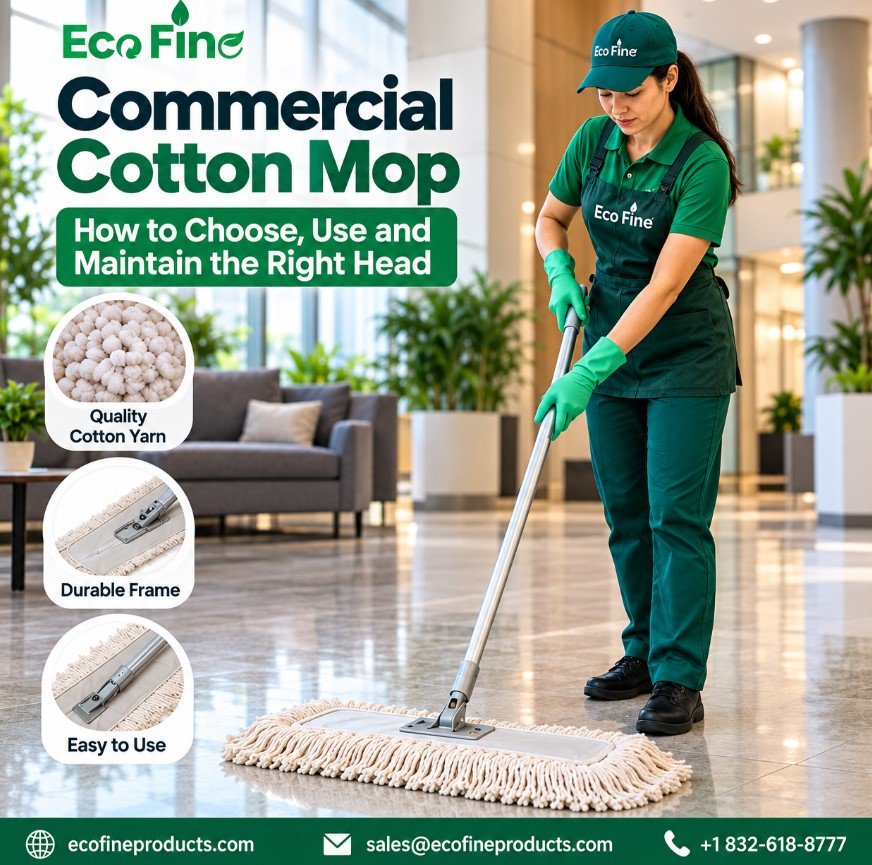
A commercial cotton mop can be a practical option for routine wet floor cleaning and ordinary liquid pickup. The right purchase depends on more than the word “cotton”: buyers should check yarn construction, headband fit, manageable working weight, wringer compatibility, and written care instructions.
For facilities already using string mops, a compatible replacement head may be more useful than changing the entire system. Before ordering in bulk, establish what the mop needs to do, who will use it, and how used heads will be cleaned or replaced.
What Makes Cotton Useful for Wet Floor Cleaning?
Cotton wet mops are commonly selected for their ability to take up and retain liquid. Ecofine describes its cotton wet mop for general commercial floor cleaning and spill pickup, making it relevant to facilities that already operate a bucket-and-wringer cleaning routine. ecofineproducts.com
However, absorption is only one part of useful performance. A head must also remain secure on the handle, move predictably across the floor, and work with the available wringer.
Start with the cotton wet mop for routine commercial floor cleaning, then confirm the specification for the version you intend to order. Product descriptions can introduce the application, but the final purchase should identify the exact head size, construction, and included components.
A cotton mop should not be treated as a universal answer for every floor or spill. Specialty flooring, unusual contamination, and chemical application require their own approved procedures.
Cut-End or Looped-End: Look Beyond the Material
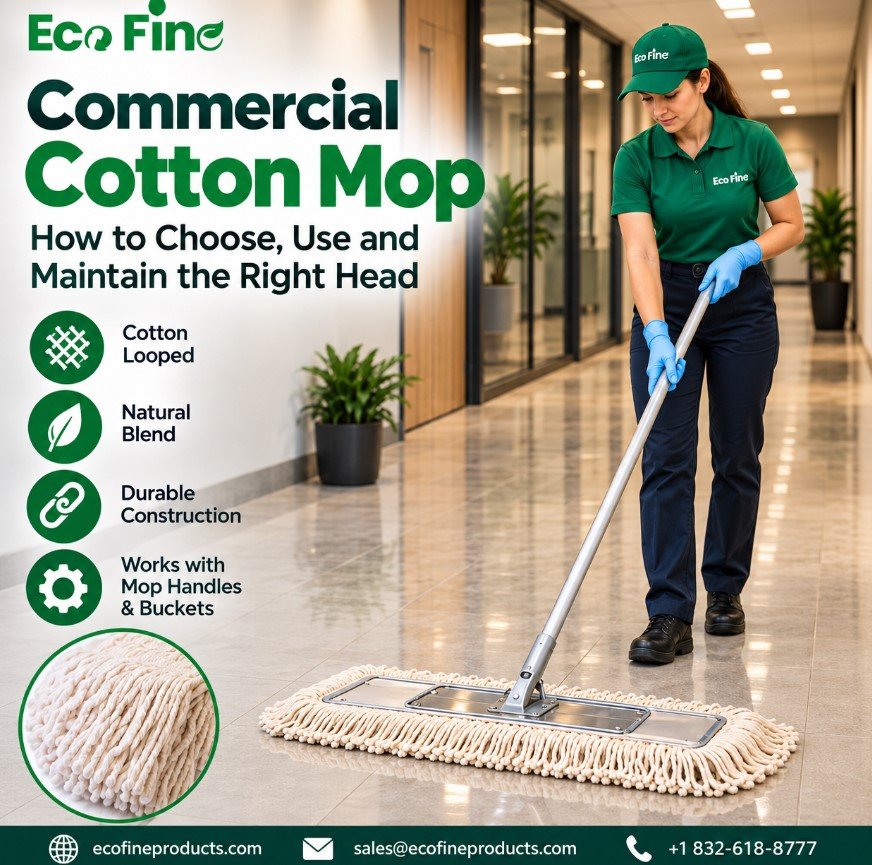
Two heads made from cotton can behave differently because their yarn ends and supporting construction differ. Cut-end mop heads have open yarn ends; looped-end heads keep the yarn ends connected.
Ecofine’s cotton looped-end wet mop for repeated floor-maintenance work is described as providing more organized yarn control and reduced fraying compared with an open-ended construction. That does not establish a fixed service life or make every looped head machine washable. ecofineproducts.com
For purchasing, inspect stitching, headband security, yarn distribution, and any tailband. Ask whether the particular head is intended for laundering or another approved care method.
Cotton Mop Construction and Quality Comparison
| Product or mop type | Material | Relevant size/attachment | Best use | Quality checks | Limitations |
|---|---|---|---|---|---|
| Cotton cut-end wet mop | Cotton yarn | Confirm yarn weight and headband fit | General wet maintenance within an approved cleaning routine | Secure band, stitching, yarn condition | Open ends may fray; confirm care requirements |
| Cotton looped-end wet mop | Cotton yarn with connected ends | Confirm weight, band, and any tailband | Repeated wet-cleaning routes where yarn control matters | Intact loops, seams, even spread | Looped construction alone does not prove washability |
| Cotton dust mop | Cotton yarn on a dry-mop backing | Confirm frame dimensions and closure | Loose dry-debris collection | Backing fit, secure attachment | A different format from a wet string mop |
| Microfiber flat wet pad | Microfiber cleaning surface | Compatible flat holder required | Suitable damp or wet-maintenance routes | Backing attachment, edges, pad condition | Does not attach to a string-mop clamp |
These are distinct product formats. Select the cleaning application first, then compare the construction within that format.
Choose a Head the Operator Can Handle Comfortably
A larger cotton mop head can carry more liquid, but the wet working weight may also make it harder to control. Buying the largest available option for every employee can create an awkward cleaning routine.
Evaluate the head after it has been prepared and wrung according to the intended procedure. Check whether the worker can guide it around fixtures, maintain floor contact, and use the wringer without struggling.
For example, an illustrative hotel program might use one manageable head size for service corridors and evaluate a different setup for larger open areas. The decision should follow the cleaning route and operator requirements rather than a single building-wide assumption.
Ask what a listed ounce rating describes. It may refer to a specified yarn or product weight; it should not be interpreted as the amount of water the mop can hold.
Check the Handle, Headband and Wringer Together
A cotton replacement head must connect securely to the existing handle. Different clamps and headband formats can require different configurations.
Send the supplier a photograph of the handle connection and measurements of the existing headband. Confirm that the ordered head can be installed without bunching, slipping, or leaving an unsecured section.
Then check the wringer. The head should fit the equipment used by the team, rather than requiring workers to force an oversized bundle through it.
Confirm whether the order covers heads alone or includes handles and other equipment. A clear purchase order should show each component, its quantity, and its specification. This helps receiving staff identify an incomplete shipment before the equipment enters service.
Cotton Wet Mops and Cotton Dust Mops Serve Different Jobs
The phrase cotton mop can cause purchasing confusion because it describes material without identifying the task. A cotton dust mop is designed around a dry-floor cleaning format; a cotton wet mop belongs to a wet-cleaning setup.
For loose dust, hair, lint, and lightweight debris, review commercial dust mops for dry floor preparation. Removing loose debris first can prevent it from becoming part of the wet-cleaning load.
If terminology is causing uncertainty, Ecofine’s explanation of dust mop and dry mop terminology for facility buyers provides relevant background.
Do not order from a material name alone. Specify “cotton wet mop replacement head” or “cotton dust mop head,” together with the attachment and dimensions you need.
Compare Cotton Mop Prices on a Consistent Basis
Purchase price is useful only when the compared items represent the same order. A head-only listing is not equivalent to a complete mop, and a case price cannot be compared directly with a single listing price.
The following figures are Ecofine category display prices checked 2026. The category display does not establish the selected weight or pack basis for each order. ecofineproducts.com
| Product | Pack quantity | Verified displayed price, USD | Calculated unit price | Price drivers | Source/date checked |
|---|---|---|---|---|---|
| Cotton Wet Mop listing | Confirm before ordering | $4.99 | Not calculated; pack basis unconfirmed | Selected weight, band, included components | Ecofine wet mop category; Oct. 3, 2026 |
| Cotton Looped-End Wet Mop listing | Confirm before ordering | $6.49 | Not calculated; pack basis unconfirmed | Construction, weight, packaging | Same source/date |
| Natural Looped-End Wet Mop listing | Confirm before ordering | $5.29 | Not calculated; pack basis unconfirmed | Confirm material composition and selected configuration | Same source/date |
Request a current quote for the exact specification. Do not assume the displayed difference represents a verified difference in cost per cleaning shift.
Include approved care, spare inventory, replacements, and delivery charges when evaluating ongoing expenditure.
Build Care and Replacement Into the Purchase
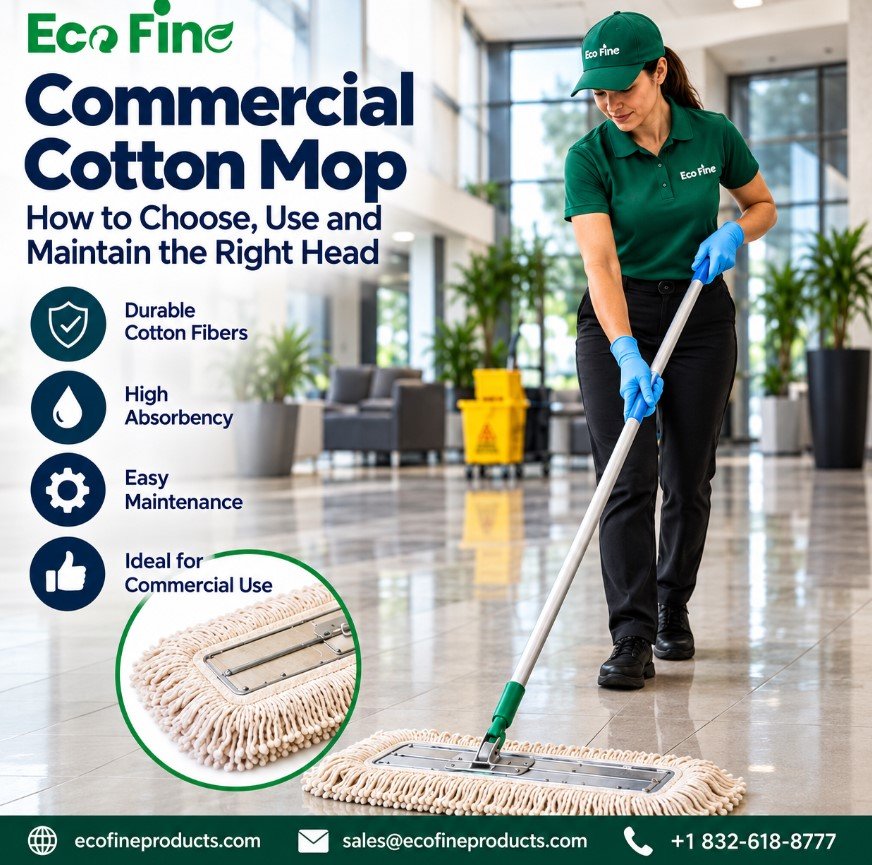
Ask for written care instructions before selecting a cotton mop for repeated use. Confirm initial preparation, cleaning method, permitted chemicals, drying requirements, and whether laundering is allowed.
Keep used heads separate from clean replacements according to the facility’s procedure. Provide a suitable drying and storage arrangement so staff are not forced to return an inadequately prepared head to service.
Inspect the headband, stitching, yarn, and attachment regularly. Replace a head when damage or deterioration prevents dependable use after its approved care process.
For buyers comparing a pad-based alternative, Ecofine’s 18-inch microfiber wet mop replacement pads in a two-pack use a different attachment system. Its wholesale microfiber mop pad article for facility managers can support that separate equipment comparison. Commercial Pack of 2
FAQs About Commercial Cotton Mops
1. What is a commercial cotton mop used for?
A cotton wet mop is an option for routine floor washing and ordinary liquid pickup within a suitable commercial cleaning procedure. Confirm the floor, cleaning solution, and equipment requirements before use. Material alone does not establish suitability for every application.
2. Is a cotton wet mop the same as a cotton dust mop?
No. A wet string mop and a dry dust mop use different formats and equipment. Specify the intended cleaning task when purchasing. Include the attachment details so the supplier does not interpret a request for “cotton mops” as the wrong product.
3. Should I choose cut-end or looped-end cotton?
Compare construction with your maintenance routine. A looped-end option is worth evaluating when yarn control and repeated handling matter. A cut-end option may fit an existing program, but confirm its approved care process and inspect samples before making a bulk commitment.
4. Does a heavier cotton mop clean better?
Weight alone does not establish better cleaning. Consider the operator’s control, the wet working weight, the floor layout, and wringer fit. A head that is difficult to move or wring can be less practical than a manageable alternative.
5. How do I confirm that a replacement head fits?
Identify the handle clamp, headband dimensions, and existing head configuration. Send photographs or measurements when necessary. Request confirmation of the exact compatible item, and test a sample before ordering replacements for several buildings or cleaning teams.
6. Can every cotton mop head be machine washed?
No universal washing rule should be applied. Confirm whether the exact head is washable and follow its approved detergent, temperature, and drying instructions. Cotton yarn does not establish how the stitching, headband, or other components will tolerate laundering.
7. Can a cotton mop be used on wood floors?
Follow the flooring manufacturer’s cleaning and moisture instructions. Do not assume a traditional wet-mopping routine is appropriate for every wood surface. The condition of the finish and the approved cleaning method are more important than the mop’s material name.
8. Why does a floor look streaky after mopping?
Review several possible causes: retained soil, incorrect solution concentration, excess moisture, contaminated equipment, or an unsuitable procedure. Streaking does not automatically prove the cotton head is defective. Check the entire cleaning process before changing products.
9. When should cotton mop heads be replaced?
Replace heads when failed stitching, damaged bands, deteriorated yarn, or persistent contamination prevents dependable use after approved cleaning. Avoid assigning an unsupported lifespan. The frequency of use, care process, and working conditions can differ substantially between facilities.
10. What should a bulk cotton mop quote include?
Request the material, construction, weight definition, headband format, pack quantity, included hardware, and care instructions. Provide the required quantity and delivery ZIP code. Ask the supplier to identify the same specification for future replacement orders.
Make the Cotton Mop Purchase Fit Your Existing Program
A dependable cotton mop purchase combines the right head construction with secure hardware fit, manageable handling, and a workable care process. Evaluate a sample on the actual cleaning route before changing the entire program.
Request a cotton mop quote with your equipment and quantity requirements. Include the handle connection, preferred construction, required quantity, floor type, and delivery location.