
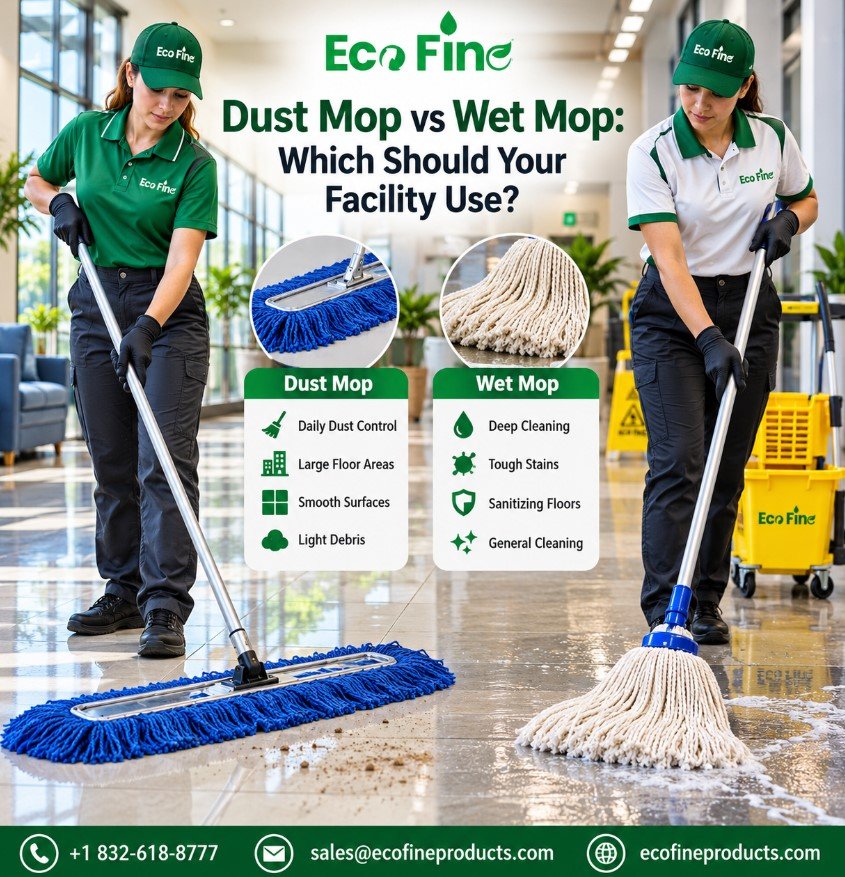
The main difference in a dust mop vs wet mop comparison is the cleaning task. A dust mop gathers loose dry debris from suitable hard floors. A wet mop supports appropriate floor washing or ordinary liquid pickup. Many commercial facilities need both because collecting dust and removing wet or adhered soil are different jobs.
Choose according to the floor’s condition, then confirm material, size, equipment compatibility, and care requirements. Buying one mop for every task can leave employees with unsuitable equipment even when the product itself is well made.
Start With the Floor Condition
Before choosing equipment, ask what needs to be removed. Loose dust, hair, lint, and lightweight debris call for a different approach from a beverage spill or sticky residue.
Ecofine’s commercial dust mops for loose dry-debris maintenance include acrylic and cotton options. Its commercial wet mops for floor washing and liquid pickup include several yarn materials and constructions. ecofineproducts.com
Consider an illustrative office corridor. Paper fibers on a dry floor may need dry debris collection. A spilled drink requires a suitable spill-cleanup procedure. The same corridor can therefore need different equipment at different times.
Do not select a tool solely because its name includes “commercial.” Match the application first.
What a Dust Mop Does—and Where Its Role Ends
A commercial dust mop provides a broad cleaning surface for gathering ordinary loose dry debris. It belongs to the dry-maintenance stage of floor care.
Ecofine describes its 24-inch acrylic dust mop for furnished commercial spaces for collecting dust, hair, lint, and lightweight debris. That is a useful application distinction, rather than a promise that it removes every type of floor soil. ecofineproducts.com
A dust mop does not replace wet cleaning for spills or adhered residue. Likewise, routine dust collection does not establish that a surface has been disinfected.
Evaluate whether the route permits the head to remain properly positioned. Furniture, doorways, and turns can make maneuverability more useful than maximum width.
For further planning, read Ecofine’s commercial dust mop article on daily floor-care routines.
When a Wet Mop Becomes the Appropriate Choice
A wet mop belongs in a procedure that calls for moisture and, where required, a compatible cleaning solution. Floor washing and ordinary spill pickup are common applications to evaluate.
Ecofine positions its cotton wet mop for routine washing and liquid pickup around cotton yarn’s absorption and retention characteristics. Confirm the selected head’s construction and equipment requirements before ordering. ecofineproducts.com
Wet mopping is not permission to saturate every floor. Follow the flooring manufacturer’s instructions for moisture and cleaning products, particularly on sensitive surfaces.
Specialized tasks also need separate consideration. Floor finish application should follow the finish manufacturer’s procedure rather than automatically using a head previously assigned to ordinary soil removal.
Ecofine’s wet mop selection article comparing construction and applications provides more detailed background.
Compare Dust Mops, String Mops and Flat Pads
Material names can cause confusion. Cotton appears in both dust mop and wet mop products, but those formats serve different applications.
Microfiber also describes a material rather than one universal cleaning task. A microfiber wet pad should be evaluated according to its stated use and matching holder.
Product, Material and Quality Comparison
| Product or mop type | Material | Relevant size/attachment | Best use | Quality checks | Limitations |
|---|---|---|---|---|---|
| Acrylic dust mop | Acrylic yarn | Ecofine lists 24-, 36-, 48-, and 60-inch options; confirm backing and frame | Loose dry-debris collection | Seams, backing fit, even spread | Does not replace spill cleanup |
| Cotton dust mop | Cotton yarn | Same listed widths; confirm closure and frame dimensions | Routine dry floor maintenance | Yarn condition, secure attachment | Different from a cotton wet string mop |
| Cotton wet string mop | Cotton yarn | Confirm selected size, headband, clamp, and wringer | Suitable washing and ordinary liquid pickup | Band, seams, attachment security | Check floor and chemical compatibility |
| Blended looped-end wet mop | Confirm fiber composition | Confirm headband and any tailband | Suitable general wet-maintenance routes | Loop integrity and stitching | “Blend” does not reveal exact percentages |
| Microfiber flat wet pad | Microfiber | Reviewed Ecofine pad: 5 × 18 inches, hook-and-loop backing | Suitable damp or wet maintenance | Backing security and edge condition | Requires a matching flat holder |
The listed formats and dimensions come from Ecofine’s categories and reviewed product information. Exact hardware combinations still require confirmation. ecofineproducts.com
Should You Remove Dry Debris Before Wet Cleaning?
Where the approved procedure calls for it, remove loose dry debris before wet cleaning. This keeps dry preparation and subsequent washing as distinct stages.
The choice is therefore often about sequence rather than selecting one permanent winner. A school may need dry corridor maintenance between scheduled wet-cleaning rounds.
For an illustrative hotel service area, the procedure might involve ordinary dry debris collection followed by suitable wet maintenance. An unexpected spill would require its own response rather than waiting for that sequence.
Do not use a dry head to absorb liquid simply because it is nearby. Keep the appropriate equipment accessible and identify its intended task clearly.
Match Size and Hardware to the Route
Dust mop width and wet mop size are not directly interchangeable purchasing measurements. A wide dust head describes coverage, while a string mop specification may describe a selected yarn or product weight.
Ecofine lists dust mop widths from 24 to 60 inches. Smaller formats deserve evaluation around furniture; wider formats may suit sufficiently open routes. Width alone does not establish square feet cleaned per hour.
For wet equipment, assess handling after preparation and wringing. Confirm headband fit, handle connection, and wringer suitability.
A microfiber flat mop pad uses another attachment system. Ecofine’s 18-inch microfiber wet mop replacement pads in a two-pack are described with hook-and-loop backing and require a compatible holder. Commercial Pack of 2
Compare Prices Without Mixing Heads and Complete Systems
A replacement head, frame, handle, and complete system are different purchasing units. Confirm what is included before comparing quotations.
The following Ecofine price snapshot was checked October 7, 2026. Category listings establish displayed prices, while some component and pack details still need order confirmation.
| Product | Pack quantity | Verified listed price, USD | Calculated unit price | Price drivers | Source/date checked |
|---|---|---|---|---|---|
| 24-inch acrylic dust mop listing | Confirm | $8.99 | Not calculated; pack basis unconfirmed | Backing, construction, included components | Dust mop category; Oct. 7, 2026 |
| 24-inch cotton dust mop listing | Confirm | $6.99 | Not calculated; pack basis unconfirmed | Material, construction, quantity | Dust mop category; Oct. 7, 2026 |
| Cotton wet mop listing | Confirm selected configuration | $4.99 | Not calculated; pack basis unconfirmed | Selected size, band, included components | Wet mop category; Oct. 7, 2026 |
| 18-inch microfiber wet replacement pads | Two pads; replacement-pad format | $15.29 per pack | Approximately $7.65 per pad | Pad construction and pack quantity | Microfiber pad product page; Oct. 7, 2026 |
These figures are purchase-format examples, not a ranking of equivalent cleaning systems. Shipping, applicable tax, hardware, and final order configuration can change total cost. ecofineproducts.com
Plan Care and Replacement Before Buying in Bulk
Obtain written care instructions for each selected product. Do not assign one laundering process to acrylic heads, cotton string mops, and microfiber pads simply because all are reusable cleaning equipment.
Inspect backing, seams, yarn, bands, and attachments. Replace equipment when damage or deterioration prevents dependable use after approved care.
Maintain enough usable replacements to support the schedule while other items undergo cleaning and drying. The quantity depends on actual operating requirements.
For bulk purchasing, record the task, material, dimensions, attachment, pack quantity, and care method. Test a sample with existing hardware before standardizing it across several locations.
Durability depends on construction, use, and care. Avoid relying on unsupported wash-cycle or lifespan figures.
FAQs About Dust Mops and Wet Mops
1. What is the main difference between a dust mop and a wet mop?
A dust mop is intended for loose dry-debris collection on suitable floors. A wet mop supports appropriate washing or ordinary liquid pickup. Choose according to the floor condition and approved procedure rather than expecting one format to handle every task.
2. Does a commercial facility usually need both?
Facilities with both dry-debris maintenance and wet-cleaning requirements may need separate equipment. Assess the actual tasks before purchasing. Some routes may also require specialized tools, so owning a dust mop and wet mop does not automatically cover every cleaning situation.
3. Is a cotton dust mop the same as a cotton wet mop?
No. Cotton identifies the material, while the product format determines its intended application. A cotton dust head uses a dry-maintenance setup; a wet string mop uses different hardware. Specify the task, attachment, and dimensions when requesting replacements.
4. Should I dust mop before wet mopping?
Remove loose dry debris first where the facility’s approved procedure requires it. Treat preparation and washing as separate stages. Spills, unusual contamination, and other conditions may require a different response, so follow the applicable procedure rather than applying one sequence everywhere.
5. Can I use a dust mop to absorb a spill?
Use equipment intended for the liquid and floor involved. A dry dust mop should not be selected as a spill tool solely because its yarn appears absorbent. Follow the facility’s response procedure and use the specified cleanup equipment.
6. Which mop size is suitable around furniture?
Evaluate clearances, doorways, and turning areas. A compact dust head or suitable flat system may be worth testing, but nominal dimensions alone do not establish fit. Ask operators to assess a sample on the actual route before standardizing equipment.
7. Will replacement heads fit any commercial handle?
No universal compatibility should be assumed. Dust heads, string heads, and flat pads use different connections. Confirm frame dimensions, closure design, headband requirements, or backing layout as appropriate. Photographs and measurements can help the supplier identify a match.
8. Can all mop heads and pads be washed together?
Follow the instructions for each product. Material and construction can require different care conditions. Confirm permitted laundering, detergent, temperature, and drying methods before combining items, and keep clean replacements separate from used equipment according to the facility’s procedure.
9. Is the cheapest listed mop the lowest-cost option?
Not necessarily. Compare equivalent units and include hardware, approved care, delivery, and replacements observed in your own program. A low-priced head that does not fit existing equipment may create additional expenditure. Confirm the specification before calculating purchasing value.
10. What should I provide when requesting a bulk quote?
Send the cleaning tasks, floor types, required sizes, material preferences, attachment details, quantities, and delivery ZIP code. State whether you need replacement surfaces or complete systems. Ask for confirmed pack quantities, included components, and written care instructions.
Choose Equipment Around the Job
A practical commercial cleaning program matches dry-debris equipment to dry maintenance and wet equipment to appropriate washing or liquid pickup. Confirm the supporting hardware and care process before approving a large purchase.
To request mop options matched to your facility’s cleaning tasks, provide floor types, preferred sizes, attachment photographs or measurements, quantities, and delivery location.