
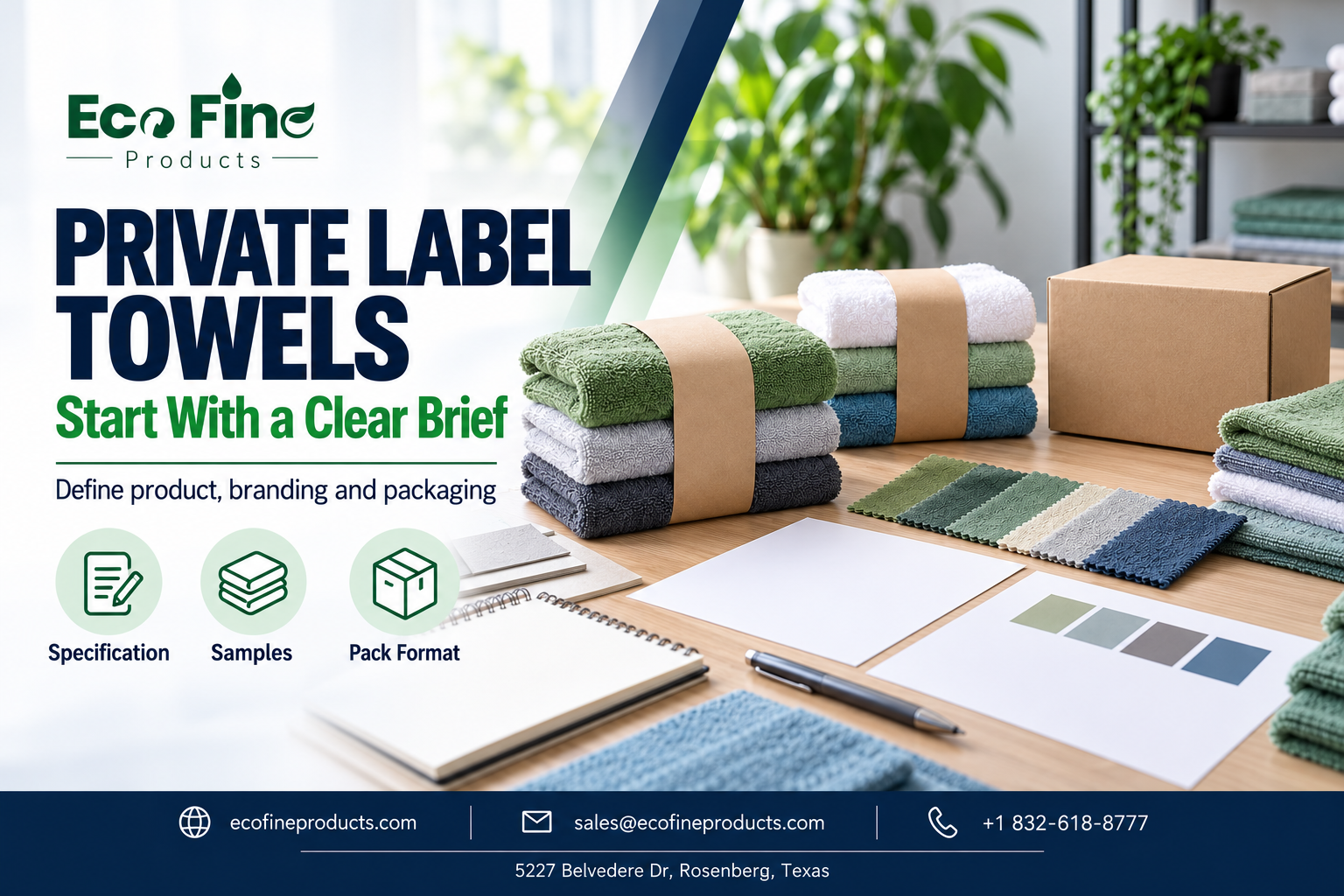
A useful private label microfiber towel brief defines the intended use, product specification, branding, packaging, sample approval, and receiving requirements before suppliers quote. Keep confirmed requirements separate from preferences and unresolved questions. A logo file alone is insufficient because the commercial offer depends on both the textile and the finished selling unit.
For distributors and growing brands, a clear brief makes quotations easier to compare and supports repeat orders. Start with a focused customer need. Expand the range after the initial specification is understood.
Begin with the customer’s actual task
Identify who will use the towel and what they expect it to do. General wiping, glass finishing, vehicle drying, and other applications can require different formats. Describe the approved surfaces and the intended cleaning method without claiming unsupported performance. This gives the supplier a reason to recommend a particular construction rather than simply quoting the heaviest option.
Separate the end user from the purchasing channel. A distributor selling cases to cleaning contractors may need different packaging from a brand selling individual retail packs. Define the selling unit, storage constraints, and product information the customer needs. Avoid assuming that attractive packaging compensates for a towel that does not suit the intended work.
Review EcoFine’s microfiber cloth categories and car-cleaning microfiber towel options as product starting points. Verify the actual specification of candidates. Do not transfer composition, dimensions, care limits, or performance claims from a similar-looking product to the item being developed.
Define the textile before approving the artwork
Record required dimensions, construction or weave, composition information, edges, color, and any substantiated mass-per-area requirement. Specify measurement conventions and tolerances when agreed with the supplier. Where the supplier proposes a value, identify it as a proposal until accepted. This prevents a provisional detail from silently becoming a purchasing requirement.
GSM describes fabric mass per area, not complete task performance. A meaningful specification considers size, construction, handling, and the finished result together. If a higher GSM is requested, state the business reason and evaluate a candidate. Do not turn the number into an unsupported guarantee of absorbency, durability, or scratch-free use.
A practical supplier-brief structure
| Brief section | Information to provide | Evidence or approval needed |
|---|---|---|
| Intended use | Customer, task, permitted surfaces | Defined application and trial procedure |
| Textile | Dimensions, construction, composition, edges | Supplier specification and accepted sample |
| Branding | Logo files, placement, approved colors | Artwork proof and physical sample where needed |
| Selling unit | Cloths per pack and packs per carton | Confirmed quantity and pack identification |
| Product information | Care, identity, supported claims | Applicable documentation and copy approval |
| Commercial terms | Quantity, timing, delivery assumptions | Written quotation and agreed order terms |
The brief should identify who approves each section. Purchasing may approve quantities while brand staff approve artwork and operations approve task suitability. Keep the final version in one controlled record. Conflicting email attachments create avoidable ambiguity when production or repeat ordering begins.
Treat branding as a separate approval
Provide usable logo assets and describe the desired branding method, placement, and size. Ask the supplier which options are available for the selected product. Do not assume that printing, embroidery, woven labels, or every packaging treatment can be supplied. Availability and suitability must be confirmed for the actual order.
Review EcoFine’s OEM and private-label service information before asking for a proposal. Request an artwork proof with dimensions and placement rather than approving a general visual impression. If the decoration may affect the intended surface contact or care process, resolve that issue through the applicable product guidance and sample assessment.
Keep textile approval separate from artwork approval. A digitally approved logo cannot establish how the towel performs, and a successful unbranded sample does not establish the appearance of the finished retail pack. Define which approval stages are required and which remain outstanding before authorizing the next stage of the order.
Make packaging quantities unambiguous
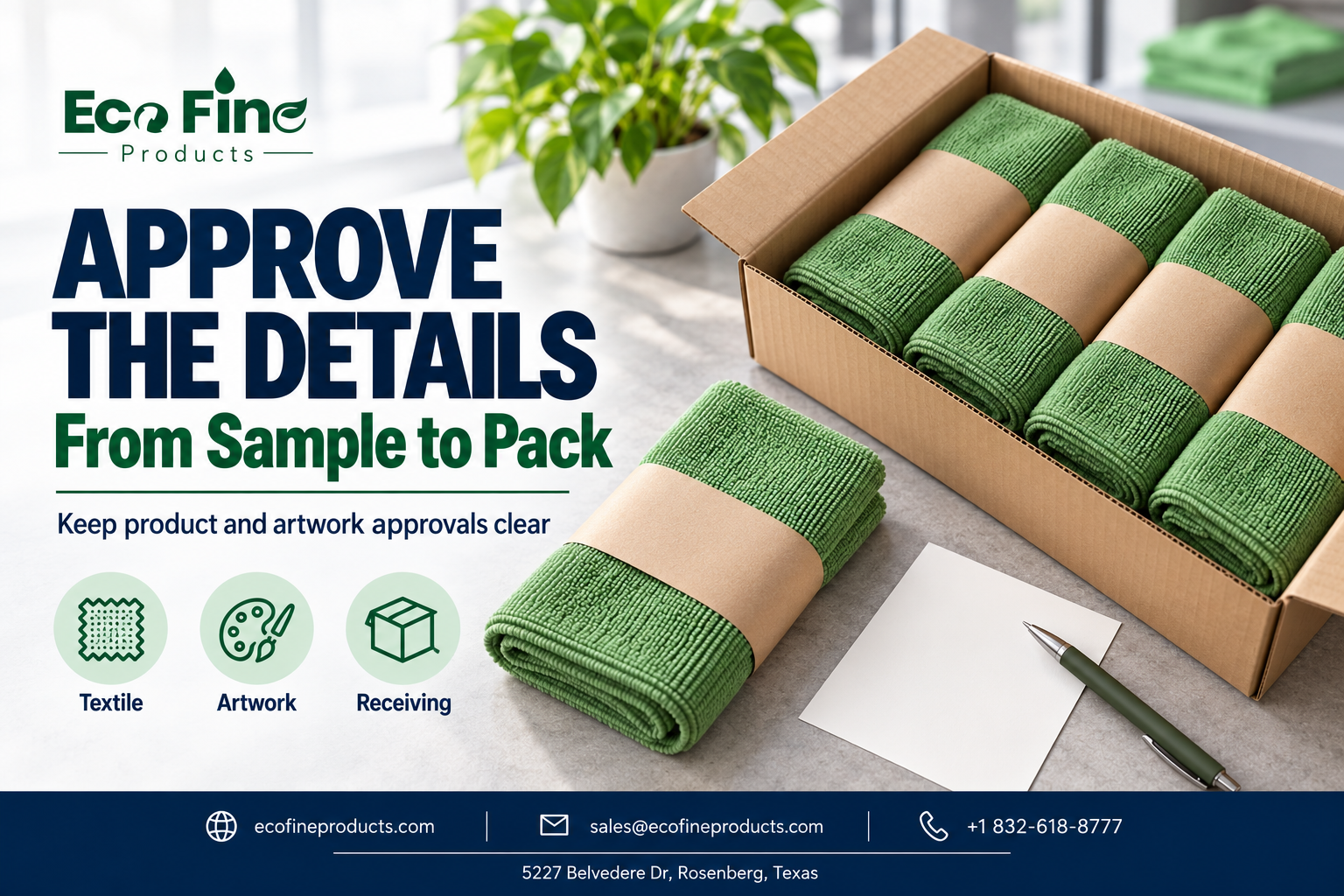
State the number of towels per selling unit, selling units per carton, and how each level will be identified. Confirm whether the quotation includes packaging or lists it separately. A price described as “per unit” is ambiguous until the unit is defined. Ask for dimensions and weights where required for your storage or distribution planning.
Describe labeling and barcode needs using the requirements of the intended channel and market. Do not invent identifiers or claim legal compliance without appropriate review. Product origin, fiber descriptions, care information, and environmental claims require accurate supporting information. Assign responsibility for checking the applicable requirements before approving final packaging copy.
Use samples to resolve purchasing questions
Request candidates that represent the proposed product and clarify whether they are prototypes or normal production examples. Define the application trial and acceptance requirements before comparing prices. Keep records of surface results, handling, and condition after approved care. Do not claim formal testing or certification from an informal workplace comparison.
Obtain the supplied product’s care instructions rather than copying another manufacturer’s limits. Unger’s microfiber laundering guidance illustrates why chemistry and processing matter, but its instructions cannot become the care label for an unrelated private-label towel. Resolve missing information with the responsible supplier before approving customer-facing instructions.
Preserve an accepted reference with its identity and approval date. Record any changes between the sample and the final order. If the supplier proposes a different edge, color, or pack arrangement, decide whether another sample is necessary. An approval should identify what was accepted, not simply say that the sample looked good.
Compare quotations on the same basis
Ask each supplier to state the product, quantity, selling unit, packaging, branding, delivery assumptions, and quotation validity. Identify setup charges and other separate costs. Confirm minimum quantities and estimated timing rather than assuming a standard private-label program. A complete comparison makes the unresolved commercial questions visible before commitment.
Use hypothetical calculations only when clearly labeled. For example, a proposed order of 600 towels packed six per selling unit produces 100 selling units before any agreed sampling or overage arrangements. That arithmetic does not establish a supplier’s minimum quantity or price. Keep your planning numbers separate from the written offer.
Questions to resolve before placing the order
- Which exact textile and sample approval does the quote reference?
- What is included in branding and packaging charges?
- How are pack, carton, and order quantities defined?
- Which documents support the proposed product claims and care copy?
- How will substitutions, deviations, and receiving discrepancies be handled?
Capture answers in the final order record. Confirm the contact responsible for commercial questions and the process for approving changes. Date artwork files so older versions cannot be mistaken for current approvals.
Prepare receiving checks before delivery
Tell the receiving team what to compare: product identity, selling-unit count, carton identification, visible condition, and relevant sample features. Use a documented inspection approach suitable for the order. Do not describe a casual selection of cartons as statistical certification. Keep questionable goods identifiable while discrepancies are reviewed with the supplier.
After the first order, compare the delivered item with customer feedback and the original purpose. Record complaints precisely and distinguish product, packaging, instruction, and handling issues. Use that evidence to improve the specification before expanding the range. This creates a repeatable program instead of a series of loosely related branded purchases.
Frequently asked questions
What is the difference between private label and OEM? Suppliers may use these terms differently. Clarify whether the proposal covers branding an existing item, modifying a specification, or developing a different product. Put the actual scope in writing rather than relying on the label alone.
Do we need a complete specification before contacting a supplier? Provide the intended use and confirmed requirements first, then identify the questions on which you need advice. A supplier can propose options. Keep those proposals separate from approved details until the responsible people have reviewed them.
Can we choose towels by GSM alone? No. Evaluate dimensions, construction, composition information, handling, care, and the intended result. GSM is one specification input. It does not establish every aspect of quality or guarantee the same performance across different towel designs.
What should an approved sample record include? Record the item identity, version, date, relevant measurements, trial result, care information, and any agreed deviations. Identify who approved it and which later stages remain open. Keep packaging and textile approvals distinct where they represent different decisions.
Are minimum quantities and lead times fixed? They depend on the supplier, product, decoration, packaging, and current arrangement. Obtain a written quotation for the intended order. Do not treat another customer’s quantity or an old estimate as a confirmed commitment for your program.
Can we put environmental claims on packaging? Use only accurate claims supported for the actual product and reviewed against applicable requirements. Reusability alone does not substantiate every environmental statement. Avoid broad certifications, biodegradability claims, or comparative savings without appropriate evidence.
Should every towel carry our logo? That depends on the customer, task, branding method, and commercial goals. Packaging branding may be an option, subject to supplier confirmation. Evaluate whether the chosen treatment affects use, care, presentation, or cost before approving it.
How do we protect consistency on repeat orders? Reference the accepted specification, current artwork, packaging version, and agreed change process. Check deliveries against that record. Review proposed substitutions before dispatch and update the controlled specification only when the change has been approved.
Make the brief useful beyond the first quotation
A strong private-label specification supports sampling, ordering, receiving, and repeat supply. Keep product evidence and commercial assumptions visible throughout the process. Contact EcoFine Products with your private-label brief to discuss the intended application, quantities, branding, and documentation needed for a comparable quotation.