
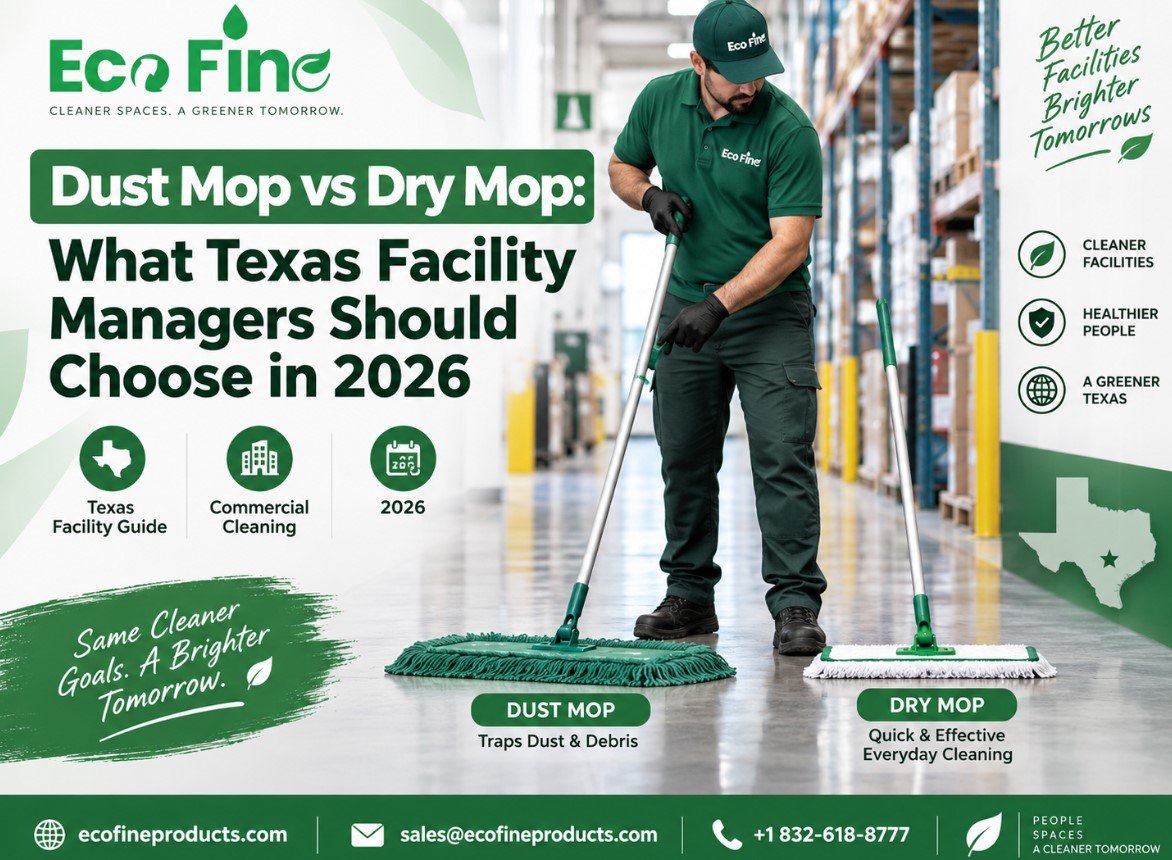
For Texas facility managers, choosing between a dust mop and a dry mop is often less complicated than the terminology suggests. In professional janitorial purchasing, these terms frequently overlap because both describe cleaning tools designed to collect loose dust, hair, lint and light debris from hard floors without introducing water.
The important question in 2026 is not simply whether a supplier calls a product a dust mop or dry mop. Buyers should look at the mop material, cleaning width, frame compatibility, floor layout and how the product will fit into the building’s complete floor-maintenance routine.
EcoFine’s commercial floor-care range includes acrylic dust mops in multiple widths, along with a professional commercial dust mop frame and compatible aluminum mop handles, allowing facilities to build a coordinated dry-floor cleaning system. EcoFine’s live frame page positions commercial dusting systems for hallways, classrooms, warehouse aisles and lobbies.
Is a Dust Mop the Same as a Dry Mop?
In many commercial settings, yes.
A dry mop describes how the mop is used: without water or cleaning solution. A dust mop describes the main job: collecting dry dust and loose debris.
That means an acrylic dust mop can also reasonably be described as an acrylic dry mop when it is being used for routine dry-floor maintenance.
However, not every dry-cleaning tool uses the same material or construction. Some facilities use acrylic yarn, others use cotton, and some use microfiber.
The correct purchase therefore depends more on the actual mop head, width and intended floor area than on one label alone.
Why Texas Facilities Use Dust Mops Before Wet Cleaning
Texas commercial buildings deal with tracked-in soil, fine dust, lint, hair and particles throughout the day. Warehouses may collect packaging debris and dry particulate matter, while schools and hotels often deal with hallway dust and high foot traffic.
Removing that loose material first can make subsequent wet cleaning more efficient.
A commercial dust mop moves across the floor and gathers dry debris without immediately introducing moisture. After the surface debris is removed, a wet mop or microfiber pad can be used for adhered soil, spills and deeper cleaning.
EcoFine also supplies microfiber wet-mopping products for facilities that need a second cleaning stage after dry dust removal.
Acrylic Dust Mop vs Cotton Dust Mop
Material is one of the biggest differences facility managers should consider.
An acrylic dust mop is typically selected for routine dry dust collection and commercial floor coverage. The yarn provides a broad working surface that can help collect loose particles across hallways, classrooms, offices and warehouse areas.
A cotton dust mop, by comparison, offers a traditional natural-yarn option. Cotton can be useful for routine floor maintenance, but the correct choice depends on the facility’s preferred cleaning system, maintenance method and replacement schedule.
EcoFine separates these product families into Acrylic Dust Mops and Cotton Dust Mops, which is useful because buyers can select material independently from size.
How Mop Width Changes Productivity
Width has a direct effect on how quickly a worker can cover open flooring.
A 24 inch dust mop gives the operator greater maneuverability around furniture, doorways and smaller rooms.
A 36 inch dust mop provides a useful middle ground for school hallways, hotel corridors, offices and medium commercial spaces.
A 48 inch dust mop covers significantly more floor and becomes more useful in warehouses, large institutional corridors and open commercial floors.
A 60 inch dust mop is intended for situations where maximum coverage matters more than tight maneuverability.
The best width is not automatically the largest. It is the width that fits the floor plan.
When a 24-Inch Dry Mop Makes Sense
A 24 inch dry mop is appropriate where cleaners frequently change direction.
Examples include classrooms, smaller offices, clinic areas, retail spaces and furniture-heavy commercial environments.
Its smaller footprint makes the head easier to position around obstacles and entrances.
Facility teams that need this kind of control can review EcoFine’s commercial acrylic dust mop range Dust Mops / Dry Mops category and match the head to a compatible frame.
When 36 Inches Becomes More Efficient
A 36 inch acrylic dust mop works well where there is enough open space to benefit from additional coverage but the floor still includes corners, doors and furniture.
This makes the size particularly useful in educational buildings, hotel corridors and commercial office environments.
A current commercial 36-inch blended dust-mop listing is around $39.62, while other current 36-inch replacement-head references can fall into the mid-$20 range depending on pack and construction.
Why 48-Inch Mops Suit Warehouses and Large Floors
A 48 inch acrylic dust mop is designed around coverage.
When a worker cleans a long warehouse aisle with a 24-inch mop, they may need substantially more passes than with a 48-inch head.
That does not mean 48 inches is ideal everywhere. In narrow rooms, the wider head can become harder to turn.
But for open Texas warehouses, convention spaces, educational corridors and large institutional floors, the productivity benefit can be substantial.
Current U.S. 48-inch market references range widely: around $29.99 for some multi-head replacement packs and roughly $46.79–$66.69 for a premium Rubbermaid 48-inch head, depending on retailer.
When a 60-Inch Dust Mop Is the Better Choice
A 60 inch dust mop is a specialist high-coverage tool.
The extra width makes the most sense on very large, unobstructed floors.
Warehouses, industrial buildings, exhibition spaces, distribution environments and large institutional facilities may benefit from this format because fewer passes can cover the same area.
Current 60-inch replacement mop-head examples are around $29.51 to $38.98, although material and construction differ.
Dust Mop Head vs Complete Dust Mop System
Buyers should distinguish between a dust mop head and a complete cleaning system.
A replacement head does not necessarily include:
frame, handle or connectors.
EcoFine’s commercial dust mop frame is intended to support compatible reusable dust-mop heads and provide broad floor contact.
Facilities can also pair the frame with commercial aluminum mop handles after confirming the attachment design.
This modular approach makes replacement easier because a worn replacement mop head can be changed without automatically replacing all hardware.
2026 U.S. Market Price Comparison
| Product Type | Typical Width | Indicative 2026 Market Reference | Best Use |
|---|---|---|---|
| Basic dust mop / head | 24″ | About $5.79+ | Smaller commercial areas |
| Commercial replacement mop head | 36″ | About $25–$40 | Corridors and medium floors |
| Commercial dust mop head | 48″ | About $30–$67 | Warehouses and large floors |
| Wide replacement dust mop head | 60″ | About $30–$39 | Very large open floors |
| EcoFine commercial system | Multiple sizes | Request current quote | B2B, wholesale and facility supply |
Market listings are not perfectly equivalent because material, quantity, brand and included hardware differ.
How to Choose the Right Dust Mop in 2026
The most practical approach is to map the building before ordering.
Small rooms need control.
Medium corridors need a balance of width and maneuverability.
Warehouses need coverage.
Facilities with several floor layouts may benefit from more than one mop width rather than trying to standardize every room around a single size.
Frame and handle compatibility should also be checked before placing a bulk order.
For a complete setup, pair your commercial replacement dust mop head with EcoFine’s commercial dust mop frame for professional dry floor cleaning and aluminum mop handles for commercial dust mop systems.
Related Products and Blogs
- Commercial acrylic dust mop collection,
- 36 inch acrylic dust mop for medium commercial areas,
- 48 inch acrylic dust mop for warehouse floors,
- 60 inch acrylic dust mop for large open facilities,
- replacement commercial dust mop frame,
- aluminum mop handle for professional dry mopping.
What is the difference between a dust mop and a dry mop?
A dust mop is designed to collect dust and loose debris, while dry mop describes cleaning without water. In commercial floor care, the two terms frequently describe the same type of tool.
Is an acrylic mop suitable for dry cleaning?
Yes. An acrylic dust mop is designed primarily for dry-floor maintenance and loose-debris collection.
What size dust mop should a small office use?
A 24 inch dust mop is usually easier to maneuver around desks, furniture and doorways.
Is a 36 inch dust mop good for schools?
Yes. A 36 inch acrylic dust mop offers useful coverage for hallways and common areas without becoming excessively wide.
Is a 48 inch dust mop suitable for warehouses?
Yes. A 48 inch dust mop is well suited to warehouse aisles and open commercial flooring where broader coverage saves time.
When should I use a 60 inch dust mop?
Choose a 60 inch commercial dust mop when the facility has large unobstructed floors where maximum cleaning width is useful.
Can I replace only the dust mop head?
Yes, when the frame and attachment system are compatible with a replacement mop head.
Do dust mops replace wet mopping?
No. Dry mopping removes loose surface debris; wet cleaning addresses spills, adhered soil and deeper contamination.
Are commercial dust mops available for wholesale orders?
Yes. EcoFine supports facility, distributor and wholesale purchasing across its professional cleaning range.
Which dust mop is best for a mixed-use facility?
A facility with small rooms and large corridors may perform better with multiple widths, such as 24-inch and 36-inch dust mops, rather than one universal size.