
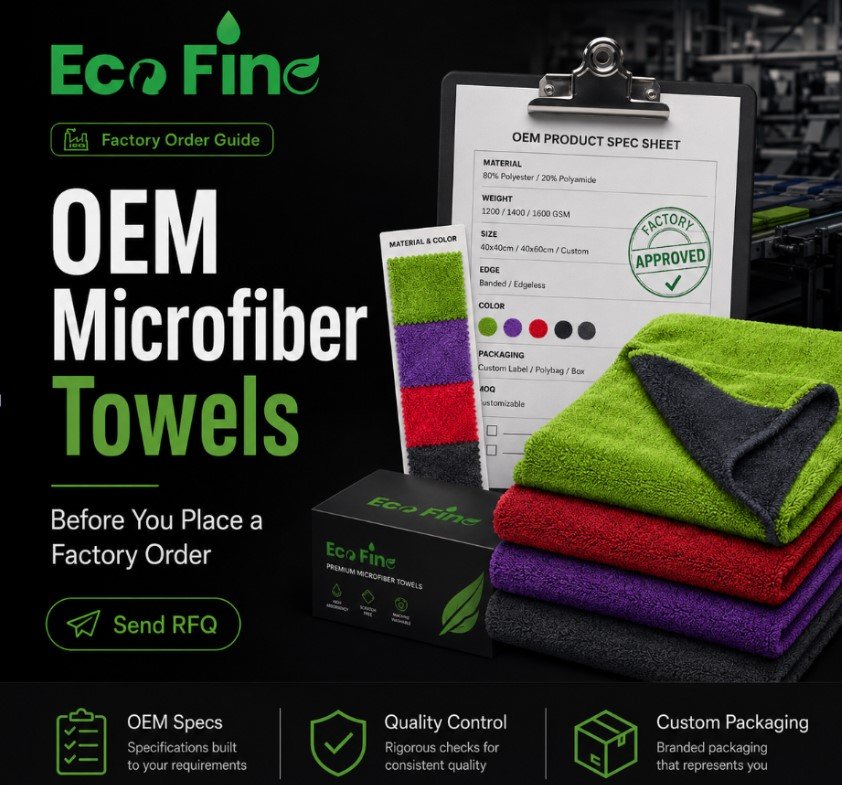
The quote may show the right size. The color may sound correct. The GSM may look impressive. The supplier may say the towel is “premium quality.” But when the shipment arrives at your warehouse in Texas or any other U.S. location, the real questions begin.
Does the towel absorb properly? Is the GSM accurate? Does it lint after washing? Does the edge feel safe on paint? Does the packaging look retail-ready? Are the carton labels correct? Will the next production batch match the first one?
That is why sourcing OEM microfiber towels requires more than asking for the lowest price. OEM buying is a specification-driven process. Every detail affects product performance, customer reviews, repeat orders, and your brand reputation.
For importers, distributors, Amazon sellers, private-label brands, car wash suppliers, janitorial companies, and commercial cleaning buyers across Texas and every U.S. city, this guide explains what to confirm before placing a factory order for microfiber towels.
OEM Is Not the Same as Buying Ready Stock
Ready-stock microfiber towels are already produced. You choose from available sizes, colors, GSM levels, and packaging. It is faster, but customization is limited.
OEM production is different. OEM stands for Original Equipment Manufacturer. In practical terms, it means the towel is produced according to your required specifications, branding, packaging, and order plan. That may include custom towel size, custom GSM, custom color combination, custom edge construction, custom label, custom packaging, custom carton marking, custom barcode or SKU setup, custom product bundles, and custom retail or wholesale packing.
OEM buying gives you control, but it also creates responsibility. If your specifications are unclear, the factory may produce something that does not match your market needs.
That is why buyers should prepare a clear RFQ before discussing price. EcoFine’s private label microfiber towels program is useful for buyers who want branding and packaging support, while this guide focuses more on factory-order decisions.
Real Market Price Table for OEM Microfiber Production
Understanding real market pricing before contacting a factory helps buyers in Texas and across the USA negotiate with confidence instead of guessing. Prices below reflect typical OEM microfiber towel factory price ranges for bulk production runs (per piece, USD, ex-packaging customization).
| Product Type | GSM | Base Unit Price | MOQ (Factory Run) | Custom Label Add-On |
|---|---|---|---|---|
| Economy cleaning cloth | 300 GSM | $0.30 – $0.55 | 5,000 pcs | +$0.03 – $0.06 |
| All-purpose towel | 350 GSM | $0.50 – $0.85 | 3,000 pcs | +$0.04 – $0.07 |
| Plush detailing towel | 500 GSM | $1.05 – $1.65 | 2,000 pcs | +$0.05 – $0.09 |
| Waffle weave towel | 300–400 GSM | $1.20 – $1.90 | 2,000 pcs | +$0.05 – $0.09 |
| Entry drying towel | 800 GSM | $2.10 – $3.00 | 1,000 pcs | +$0.07 – $0.12 |
| Premium drying towel | 1200 GSM | $3.30 – $5.20 | 500 pcs | +$0.08 – $0.15 |
| Premium-plus drying towel | 1400 GSM | $4.30 – $6.40 | 500 pcs | +$0.09 – $0.16 |
| Ultra-premium drying towel | 1600 GSM | $5.50 – $8.00 | 300 pcs | +$0.10 – $0.18 |
Note: Factory pricing changes with blend ratio, weave type, packaging complexity, and shipping destination within the USA, including Texas, California, and the East Coast. Always request an updated factory quote with your exact specification sheet.
For a full breakdown of bulk drying towel pricing, review 1200 GSM wholesale car drying towel bulk pricing.
The Six Decisions That Shape Every OEM Order
Before price negotiation, make these six decisions.
| Decision | Why It Matters | Example |
|---|---|---|
| Product type | Defines fabric and use case | Car drying towel, glass cloth, mop pad |
| GSM | Controls weight, feel, absorbency and cost | 300, 350, 500, 800, 1200, 1400, 1600 GSM |
| Weave | Determines performance | Twisted loop, waffle weave, plush, coral, short pile |
| Blend | Affects softness and absorbency | 80/20 or 70/30 polyester/polyamide |
| Edge | Impacts durability and paint safety | Overlock, edgeless, silk edge, microfiber border |
| Packaging | Affects retail value and logistics | Poly bag, carton, bale, box, belly band |
A professional OEM buyer does not start with “What is your cheapest microfiber towel?” A better question is: “Can you produce a 24 x 36 inch 1200 GSM twisted-loop microfiber car drying towel in purple/gray and lime green/gray, with black retail poly bag packaging, custom logo label, barcode, carton markings, and pricing for 500, 1,000, and 5,000 units, shipped to Texas?”
That question gives the supplier enough information to quote properly.
Product Type Comes First in Every Factory Order
Not all microfiber towels are built for the same purpose.
A towel used to dry a vehicle needs a different structure from a towel used to clean hotel mirrors. A towel for ceramic coating removal should not be selected the same way as a janitorial cleaning cloth. A mop pad has a completely different construction from a car buffing towel.
Common OEM microfiber categories include car drying towels, twisted loop drying towels, glass cleaning cloths, waffle weave towels, buffing towels, ceramic coating towels, commercial microfiber cloths, microfiber mop pads, coral dust mop pads, hotel housekeeping towels, restaurant cleaning cloths, and janitorial microfiber towels.
If the use case is unclear, the whole order becomes risky. A 1200 GSM towel may be excellent for premium car drying towels for auto detailers, but it is not practical as a restaurant wiping cloth. A 300 GSM cloth may work well for commercial janitorial microfiber cloths, but it will not create the premium experience expected from a D2C car care towel.
GSM: Do Not Use It as a Marketing Number
GSM is one of the first specs buyers notice, but it must be connected to performance and cost.
| GSM Range | Best OEM Application | Typical Buyer |
|---|---|---|
| 300 GSM | General cleaning cloths | Janitorial suppliers, restaurants |
| 350 GSM | All-purpose microfiber towels | Cleaning companies, auto interiors |
| 500 GSM | Plush detailing towels | Detailers, car care brands |
| 800 GSM | Entry premium drying towels | Retail kits, value car care |
| 1200 GSM | Premium drying towels | Amazon sellers, distributors, car washes |
| 1400 GSM | Premium-plus drying towels | D2C brands, pro detailers |
| 1600 GSM | Ultra-premium drying towels | Flagship car care products |
Higher GSM usually means a heavier towel, but not every buyer needs a heavier towel. For OEM programs, GSM affects unit cost, carton quantity, shipping weight, packaging size, retail price, product photography, customer perception, and storage space.
Buyers comparing heavy drying towels should review 1200 GSM vs 1400 GSM vs 1600 GSM car drying towels before finalizing their OEM product ladder.
Weave Selection: A Layer Buyers Often Miss
Weave determines how the towel behaves during use.
A twisted-loop towel is designed for high water absorption. A waffle weave towel is useful for glass and lighter drying. A plush towel is better for buffing and finishing. A coral fleece surface may work well for cleaning or dusting applications.
| Weave Type | Best Use | Common OEM Buyer |
|---|---|---|
| Twisted loop | Vehicle drying | Car care brands, car washes |
| Waffle weave | Glass, mirrors, windows | Auto glass, hotels, janitorial |
| Plush pile | Buffing and detailing | Detailers, retail towel brands |
| Short pile | Coating removal | Ceramic coating installers |
| Coral microfiber | Dusting and cleaning | Facility cleaning, janitorial |
| Mop pad fabric | Floor cleaning | Commercial cleaning suppliers |
For automotive buyers, twisted loop is usually the priority weave, as explained in twisted loop drying towels for professional detailers. For commercial cleaning buyers, waffle weave glass cloths and color-coded microfiber cloths may be more important, covered further in best microfiber glass cleaning towels guide.
Blend: 80/20 vs 70/30 Is a Positioning Decision
Most microfiber towels are made from polyester and polyamide. Polyester contributes structure and durability. Polyamide contributes softness and absorbency.
| Blend | Strength | Best Fit |
|---|---|---|
| 80/20 | Durable, cost-effective, widely used | Wholesale, janitorial, car wash, value premium |
| 70/30 | Softer, more absorbent, premium positioning | High-end detailing, D2C retail, luxury car care |
A premium automotive brand may choose 70/30 for softer positioning. A wholesale janitorial supplier in Texas may choose 80/20 for price and durability. A car wash chain may focus more on cost per use than luxury hand-feel. There is no universal best blend — only the best blend for the buyer’s market.
Color and Branding: Build Recognition, Not Confusion
OEM microfiber towel buyers often focus on logo placement but underestimate color strategy.
For automotive towels, strong two-tone combinations can improve marketplace photos and retail shelf appeal, such as black + gray, blue + gray, purple + gray, red + gray, and lime green + gray.
For commercial cleaning, color has a functional role:
| Color | Common Commercial Use |
|---|---|
| Blue | Glass and general cleaning |
| Red | Restrooms or high-risk areas |
| Green | Foodservice or kitchen areas |
| Yellow | Low-risk cleaning tasks |
| Gray/Black | Automotive, utility, or heavy-use areas |
Branding options may include woven label, printed label, heat-transfer label, care label, belly band, retail pouch, insert card, or carton label. For buyers building a full retail product, packaging and branding should be planned before sampling.
Packaging: The Factory Must Know the Sales Channel
A towel sold to a car wash chain does not need the same packaging as a towel sold on Amazon.
| Sales Channel | Recommended Packaging |
|---|---|
| Amazon | Retail poly bag, barcode, insert card |
| Shopify | Premium pouch, branded packaging, product story |
| Distributor | Carton packs, SKU labels, bulk-ready cartons |
| Car wash chain | Bulk carton or bale packaging |
| Janitorial supplier | Bale, carton, or color-coded case pack |
| Retail store | Hanging pouch, display-ready bag, rigid card |
For EcoFine’s towel range, black poly bags, transparent poly bags, carton packaging, and bale packaging all have a role. A premium 1200 GSM drying towel wholesale program may look excellent in a clear-front black pouch, while a 300 GSM cleaning cloth program may be better packed by carton or bale.
Buyers should confirm packaging dimensions, folded towel size, barcode placement, carton quantity, and shipping carton strength before production.
Sample Approval: The Most Important Step
A sample is not just for appearance. It is a pre-production test.
Before approving an OEM microfiber towel sample, check size accuracy, GSM feel and weight, color match, edge quality, label placement, absorbency, linting, color bleeding, shrinkage after washing, packaging fit, barcode readability, and carton packing plan.
For car drying towels, test the sample on a clean wet vehicle. Use it on paint and glass. Wash it, dry it, then test again. For commercial cleaning cloths, test repeated wiping, washing, and color stability. A sample should never be approved only because it looks good in photos.
Quality Control Before Shipment to Texas
OEM buyers should agree on quality checkpoints before production, including raw material check, size measurement, GSM verification, stitching and edge inspection, color inspection, absorbency testing, lint check, packaging inspection, carton labeling review, and final random inspection.
For private-label buyers, incorrect labels or packaging can be just as damaging as poor towel quality. A great towel packed with the wrong barcode, wrong color label, or missing carton details can create marketplace and warehouse problems for buyers in Texas or any other location. This is why serious OEM programs require specification sheets and approval samples, as outlined in affordable wholesale microfiber towels for high-volume buyers.
Common OEM Buying Mistakes to Avoid
Avoid asking only for the lowest price, not confirming GSM properly, choosing a towel without testing it after washing, using unclear color references, forgetting packaging dimensions, not specifying edge type, ignoring carton quantity and weight, using generic product photos instead of real samples, not checking barcode or label requirements, placing a large first order without sample approval, and selecting a supplier that does not understand the final sales channel.
The best OEM orders are specific. The worst OEM orders are vague.
The Ideal OEM Microfiber Towel RFQ
Here is a professional RFQ example:
“Please quote OEM microfiber towels for a private-label car care brand. Product: 24 x 36 inch 1200 GSM twisted-loop car drying towel. Blend: 80/20 or 70/30 options. Colors: purple/gray, red/gray, lime green/gray. Edge: premium soft edge or edgeless option. Packaging: black zipper poly bag with custom logo, barcode, and insert card. Quantity: 500, 1,000, and 5,000 pcs pricing. Destination: Texas. Please include sample cost, production lead time, carton quantity, carton size, gross weight, and private-label options.”
This RFQ gives the supplier enough detail to quote accurately and recommend improvements. Explore EcoFine’s full OEM/ODM microfiber product services for custom branding support.
Final Factory Order Checklist
Before placing an OEM microfiber towel order, confirm product type, size, GSM, blend, weave, edge type, color, logo method, label placement, packaging style, barcode, carton quantity, sample approval, production timeline, quality control standards, and reorder plan. This checklist protects both the buyer and the supplier.
Final Recommendation for Texas and USA Buyers
OEM microfiber towels can become a profitable product category when the order is planned correctly.
The best buyers do not simply ask for “microfiber towel price.” They define the market, use case, GSM, weave, blend, color, edge, packaging, and quality expectations before requesting a quote.
EcoFine Products, based in Texas, supports wholesale buyers, importers, distributors, Amazon sellers, Shopify brands, car wash chains, janitorial suppliers, and commercial cleaning companies across every U.S. city and location with OEM microfiber towels and private-label packaging, custom colors, carton supply, and bulk manufacturing support.