
Dust Mop Replacement Heads: How to Avoid Fit and Purchasing Mistakes
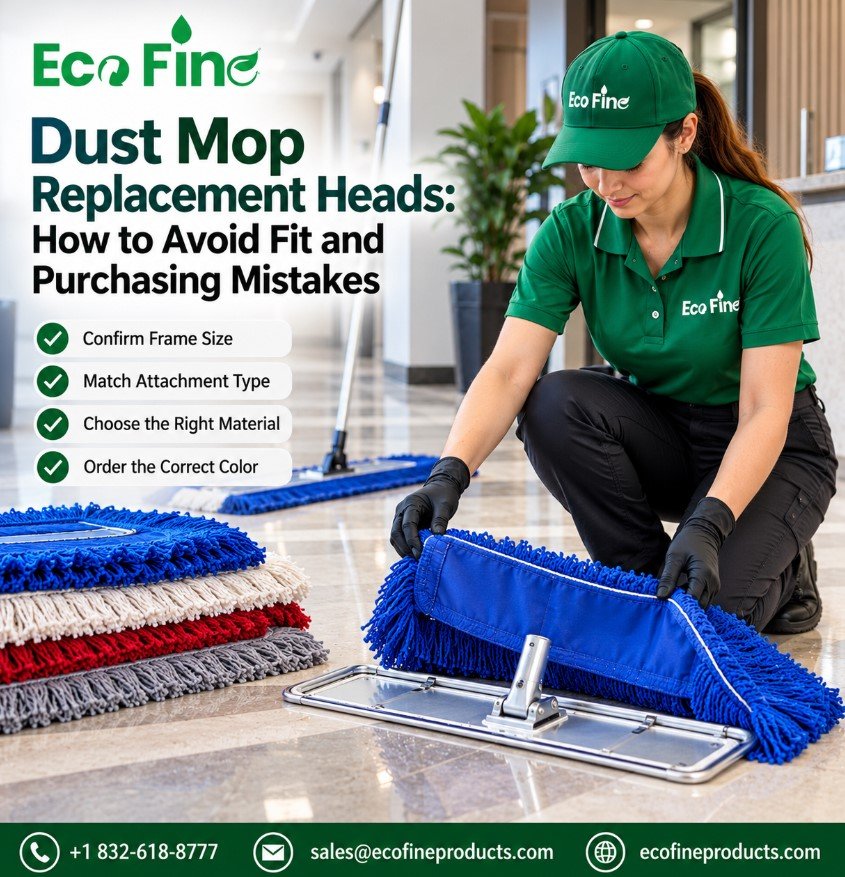
Choosing dust mop replacement heads requires more than matching the advertised length. Confirm frame dimensions, backing fit, closure design, material, and approved care instructions. Also check whether the existing frame and handle remain serviceable. For commercial facilities, replacing the head can preserve a useful cleaning setup, but only when the new component fits correctly. A head that slips, bunches, or leaves the frame poorly supported can interrupt daily maintenance. Inspect the equipment first, then select the replacement around the cleaning route and confirmed specifications.
Identify What Needs Replacing
Start by separating head problems from hardware problems. Worn yarn or failed stitching may call for a replacement head, while a bent frame or loose connection requires attention to the supporting equipment. Inspect the complete setup before preparing the purchase order. Check backing, closures, seams, frame shape, and the handle connection. Ecofine’s commercial dust mop collection for replacement and equipment comparisons lists acrylic and cotton dust mop products alongside a separate frame listing. Confirm the components included in the specific order. Do not replace a usable head simply because damaged hardware prevents good positioning. Equally, a sound frame cannot correct a head whose backing no longer attaches securely.
Why Matching the Length Is Not Enough
Two heads described with the same nominal length may have different backing dimensions or closure arrangements. Measure the existing frame rather than relying on memory. Record its length and width, then photograph how the current head attaches. Ask the supplier to confirm whether the replacement backing accommodates those dimensions. If the product specification is incomplete, request the missing details before buying. Ecofine’s commercial dust mop frame for a confirmed compatible setup is a relevant hardware destination, but its listing should not be interpreted as universal compatibility with every yarn head. For a facility operating several frame types, label the equipment and replacement inventory clearly.
Compare Acrylic and Cotton Without Assuming Universal Superiority
Material is one part of the replacement decision. Backing, stitching, yarn arrangement, attachment, and care requirements also deserve attention. For compact routes, compare the 24-inch acrylic dust mop for controlled commercial maneuvering with the 24-inch cotton dust mop for routine dry maintenance. Evaluate the proposed heads under the same conditions. Use the same route and approved procedure, then compare fit, handling, and condition after permitted care. Treat the head and hardware as a matched system, even when they are purchased separately.
Test a Sample Before Changing Materials or Suppliers
A sample can reveal compatibility problems before they affect the entire inventory. Install it on the intended frame and handle. Check that the backing fits, the closure stays secure, and the head remains positioned during normal movement. Then evaluate it on a representative route using the approved procedure. Ask the operator about turning, positioning, and any repeated adjustment. An illustrative office evaluation might include a corridor, furnished room, and doorway turn. This is more useful than testing only on an empty section of floor.
Match the Care Instructions to Your Facility
Before purchasing, obtain instructions for debris removal, cleaning, drying, storage, and any permitted treatment. Do not assume all acrylic or cotton heads share the same care process. Backing, seams, and closures may influence the permitted method. Keep enough clean replacements to support the schedule while other heads undergo approved care. Base quantities on actual turnaround rather than an arbitrary spare-head rule. Inspect heads after care for damaged stitching, insecure closures, deteriorating yarn, or backing problems. Review frames separately. Replace equipment according to condition and dependable use. An unsupported fixed lifespan can create unnecessary purchases or leave unsuitable equipment in service.
Equipment Comparison Checklist
| Check | Options | Decision |
|---|---|---|
| Cleaning task | Loose dry debris | Use a suitable dry-maintenance head |
| Working width | 24, 36, 48 or 60 inches | Match clearances and turning space |
| Hardware | Head, frame and handle | Confirm dimensions and attachment |
| Maintenance | Product-specific care | Inspect backing, yarn and closures |
Frequently Asked Questions
Can I buy a head without replacing the frame?
Yes, when the frame remains serviceable and a compatible replacement is available. Inspect its shape and connections first. Confirm the new head’s backing and closure dimensions so replacing the cleaning surface preserves a usable equipment setup.
Will every 24-inch head fit a 24-inch frame?
Do not assume so. Nominal length does not establish backing width, closure design, or usable fit. Measure the frame and request written compatibility confirmation. Test a sample when the specification is incomplete or the equipment is unfamiliar.
Should I replace cotton heads with acrylic?
Evaluate the actual products before changing materials. Compare fit, handling, permitted care, and purchasing cost on the same route. A material change should follow useful evidence from your facility rather than an assumption that every acrylic head performs better.
What size works around office furniture?
A 24-inch option is worth evaluating for tighter commercial routes, but measure the available clearances first. Doorways, desks, and turning spaces matter. A building may benefit from one size for furnished rooms and another for open corridors.
Is a cotton dust mop suitable for spills?
Select equipment intended for the liquid and floor involved. A cotton dust mop is a dry-maintenance format, and cotton material alone does not make it a wet-cleaning tool. Use the facility’s approved spill procedure and appropriate equipment.
Can replacement heads be machine washed?
Confirm the exact item’s instructions. Do not infer washability from material or appearance. Obtain detergent, temperature, and drying requirements where laundering is permitted, and verify that the facility’s available process can follow those requirements.
Why does a new head bunch on the frame?
Review backing fit, closure position, and frame dimensions. Also inspect the hardware for damage. Bunching may indicate a mismatch or installation problem rather than unsuitable yarn. Resolve the cause before approving the same replacement for a larger order.
When should I replace the frame itself?
Replace or remove hardware that cannot provide secure support because of damage, bending, loose connections, or other unsuitable conditions. A new head will not correct every frame problem. Inspect the matched system rather than judging only the yarn.