
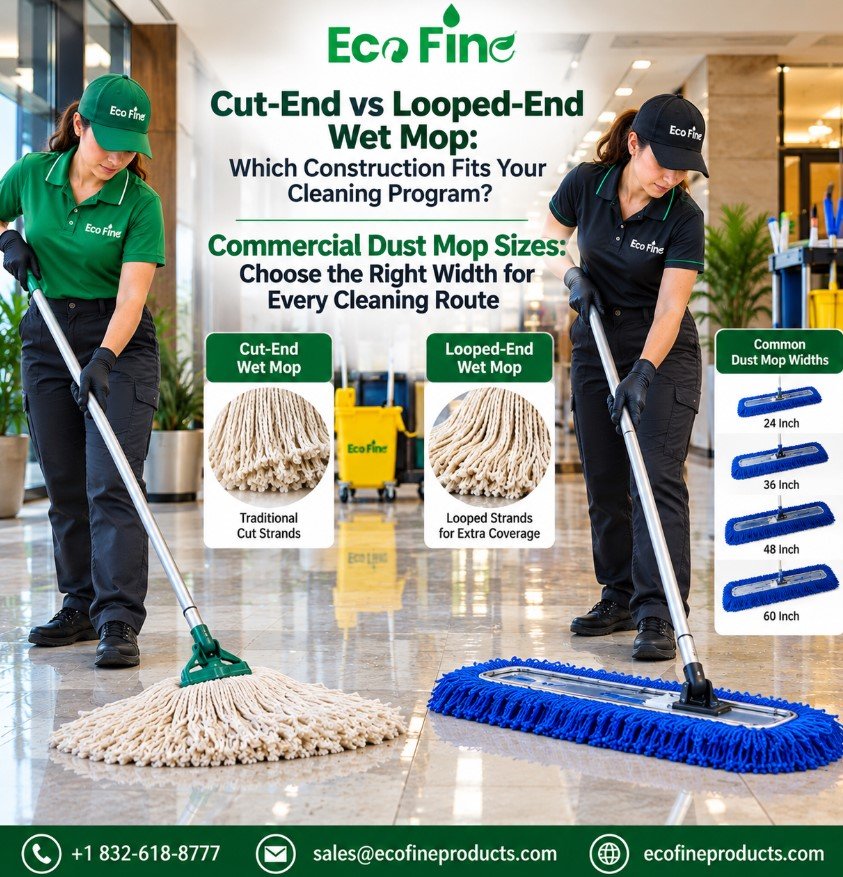
The main difference in a cut-end vs looped-end wet mop comparison is yarn construction: cut-end heads have open yarn ends, while looped-end heads keep those ends connected. For commercial buyers, the better choice depends on handling, approved care, existing hardware, and the cleaning task—not construction alone.
Compare equivalent materials and sizes before deciding. A looped-end cotton head and a cut-end rayon head differ in both construction and material, so their price difference cannot be attributed only to the ends. Start with your cleaning requirements, then evaluate the complete head.
What Changes When the Yarn Ends Are Connected?
End construction affects how the yarn is arranged during use. Open ends and connected loops create different working formats, but other components also influence the result.
Inspect the headband, stitching, yarn distribution, and any tailband. Ask how the head should be prepared, maintained, and attached to the intended handle.
Ecofine provides separate cut-end wet mop options for commercial cleaning programs and looped-end wet mop options for repeated floor maintenance. These categories help buyers identify construction choices before comparing individual products.
Do not assume that every looped head is washable or that every cut-end head has the same replacement requirements. Confirm the exact specification rather than applying a rule to the whole category.
Keep Material and Construction Separate
Cotton, rayon, and blended yarn describe materials. Cut-end and looped-end describe the arrangement of those materials.
This distinction matters when evaluating samples or supplier quotes. Compare similar head sizes and attachment formats wherever possible, then identify which differences remain.
Ecofine’s cotton looped-end wet mop for routine commercial cleaning is described as combining cotton absorption with connected yarn ends. Its blended looped-end wet mop for general maintenance routes uses mixed yarn in a looped construction. ecofineproducts.com
For blended products, request the fiber composition. “Blend” alone does not establish percentages, chemical compatibility, or an approved laundering method.
Wet Mop Construction and Quality Comparison
| Product or mop type | Material | Relevant size/attachment | Best use | Quality checks | Limitations |
|---|---|---|---|---|---|
| Cotton cut-end wet mop | Cotton yarn | Confirm selected size and headband | Suitable general wet cleaning and ordinary liquid pickup | Band security, seams, yarn condition | Open ends may fray; confirm care |
| Cotton looped-end wet mop | Cotton yarn with connected ends | Confirm band, size, and any tailband | Suitable repeated wet-maintenance routes | Intact loops, stitching, organized spread | Construction alone does not establish washability |
| Blended looped-end wet mop | Confirm mixed-fiber composition | Confirm band and selected configuration | Suitable general commercial maintenance | Loop integrity, secure band, yarn distribution | Material percentages need confirmation |
| Rayon cut-end wet mop | Rayon yarn | Confirm size and handle connection | Approved tasks matching the selected product | Yarn condition and application instructions | Do not assume universal chemical compatibility |
| Microfiber flat wet pad | Microfiber | Matching flat holder and backing required | Suitable damp or wet maintenance | Backing attachment and edge condition | Uses a different system from a string mop |
Use the comparison to identify purchasing questions. It does not rank every product in one construction above every product in another.
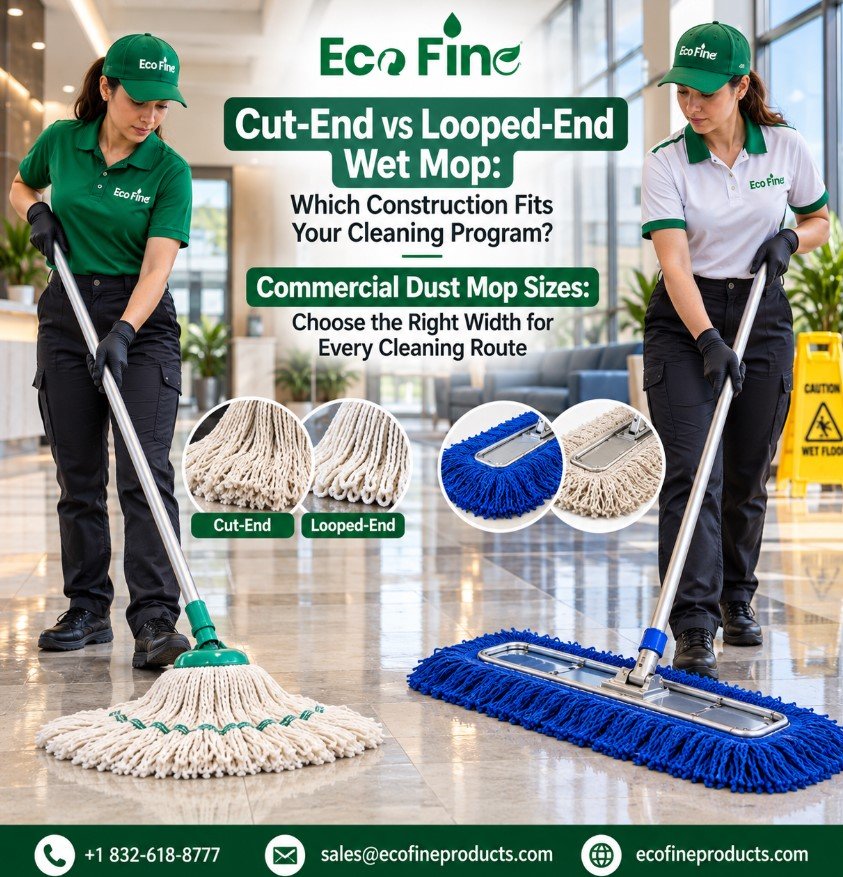
When Should a Buyer Evaluate Cut-End Heads?
A cut-end head deserves evaluation when its application, hardware fit, and approved care process match the existing program.
The decision should include how the head behaves during actual work. Does it remain securely attached? Can the operator guide it around fixtures? Does the selected head fit the wringer?
An illustrative contractor might already use a compatible cut-end specification at several small facilities. Before changing that program, compare an alternative under the same conditions rather than assuming the change automatically improves results.
Record the reasons for retaining or replacing the specification. Purchase price is relevant, but handling problems, unsupported care requirements, or unsuitable equipment fit deserve attention too.
When Should a Buyer Evaluate Looped-End Heads?
Looped-end heads are worth evaluating where yarn organization during repeated handling matters to the cleaning team.
Ecofine describes its looped-end products around connected yarn, controlled spread, and reduced fraying compared with open-ended construction. Those descriptions do not provide a verified lifespan for your facility. ecofineproducts.com
Assess the entire head, including its band and any tailband. Confirm whether the final ordered configuration matches the sample.
For an illustrative school cleaning route, the evaluation could include corridors, cafeteria furniture, and storage areas. Ask the operator to identify repeated adjustments or handling difficulties.
The purpose of the trial is a practical purchasing decision for that route, not a universal performance claim.
Confirm Handle and Wringer Compatibility
A new head must work with the existing equipment. Material and end construction do not establish handle compatibility.
Identify the clamp or connection, measure the headband, and send photographs where useful. Ask the supplier to confirm the compatible configuration in writing.
Headband format is a genuine equipment consideration: manufacturer documentation distinguishes recommended handle styles for different band formats. That guidance is product-specific and should not be transferred automatically to Ecofine heads.
Evaluate wringer fit separately. A head that is difficult to wring can create an awkward routine even when it attaches correctly.
Also assess working weight after preparation. The operator needs manageable control, not simply the largest head listed in the catalog.
Compare Prices on an Equivalent Basis
Start with the commercial wet mop range for material and construction comparisons, then request an order-specific quote.
The following figures are Ecofine category display prices checked October 7, 2026. Pack quantities and selected configurations require confirmation. ecofineproducts.com
| Product | Pack quantity | Verified displayed price, USD | Calculated unit price | Price drivers | Source/date checked |
|---|---|---|---|---|---|
| Cotton Wet Mop listing | Confirm | $4.99 | Not calculated; pack basis unconfirmed | Selected size, band, included components | Ecofine wet mop category; Oct. 7, 2026 |
| Cotton Looped-End Wet Mop listing | Confirm | $6.49 | Not calculated; pack basis unconfirmed | Construction, size, packaging | Same source/date |
| Blended Wet Mop listing | Confirm | $6.49 | Not calculated; pack basis unconfirmed | Composition and selected configuration | Same source/date |
| Blended Looped-End Wet Mop listing | Confirm | $7.99 | Not calculated; pack basis unconfirmed | Composition, construction, order quantity | Same source/date |
These listing prices are not a controlled performance comparison. Confirm equivalent weights, pack quantities, hardware inclusions, and delivery costs before calculating the purchasing difference.
Build Care Into the Selection
Ask for written preparation, cleaning, and drying instructions before committing to either construction.
A reusable head must fit the facility’s available care process. Confirm laundering where permitted, including any detergent, temperature, and drying restrictions.
Inspect the headband, stitching, yarn, and attachment after care. Replace a head when damage or deterioration prevents dependable use.
For material-specific background, read Ecofine’s commercial cotton mop article covering fit and care. For broader equipment choices, consult its wet mop selection article comparing materials and applications.
A microfiber flat wet pad is a separate format with different hardware. A dust mop is intended for dry-debris maintenance. Neither should be treated as a direct string-head replacement without evaluating the full system.
FAQs About Cut-End and Looped-End Wet Mops
1. What is the main difference between cut-end and looped-end heads?
Cut-end heads have open yarn ends, while looped-end heads keep the ends connected. Compare the complete construction, including stitching, band, and material. Those details, together with the application and care process, determine whether the proposed head suits your program.
2. Are looped-end mops always the better purchase?
No universal ranking applies. A looped head is worth evaluating for organized yarn handling, but the complete product must fit the task, hardware, and care routine. Compare samples under the same conditions before changing an established commercial cleaning specification.
3. Can cotton mops have either construction?
Yes, cotton yarn can appear in cut-end and looped-end formats. That makes material-matched comparisons useful. Confirm size, headband, packaging, and approved care as well, so the purchasing decision does not confuse construction differences with other product differences.
4. Does looped-end construction mean machine washable?
Do not assume so. Obtain the instructions for the exact product. The yarn, band, seams, and other components may have specific care requirements. Confirm permitted laundering and drying before placing the head into an existing commercial laundry routine.
5. What is a tailband, and should I request one?
A tailband holds part of the yarn arrangement together. If it matters to your handling requirements, confirm whether the proposed head includes one and inspect the sample. Do not assume every product described as looped-end has the same tailband configuration.
6. Will both constructions fit my current handle?
Compatibility depends on the connection and headband rather than the yarn ends alone. Record dimensions and provide photographs to the supplier. Request confirmation of the exact compatible item, then check the sample before purchasing replacements for several sites.
7. Should I choose the largest available head?
Evaluate handling after preparation and wringing. A larger head may be difficult to control or unsuitable for the existing wringer. Match the selected configuration to the operator, route, and equipment instead of assuming a larger nominal size always improves productivity.
8. Can either construction apply floor finish?
Follow the finish manufacturer’s instructions and use a suitable dedicated specification. Do not automatically reassign an ordinary soil-removal head to finish application. Material, construction, preparation, and cleanliness all need consideration for that separate task.
9. How should I compare the ongoing costs?
Include purchase price, required hardware, approved care, spare inventory, and replacements observed in your own program. Compare equivalent products and pack quantities. Avoid using invented lifespan or wash-cycle figures to make one construction appear less expensive.
10. What should I provide for a bulk quotation?
Send the application, preferred material, end construction, selected size, headband details, required quantity, and delivery ZIP code. State whether the order needs heads only or complete systems. Ask for pack quantities and written care instructions before approval.
Choose the Construction Your Team Can Use Consistently
The right choice combines application suitability, manageable handling, secure fit, and a workable care process. Approve a sample before changing the specification across the entire cleaning program.
Request wet mop options matched to your handles and maintenance routine. Include the preferred construction, band measurements, quantity, floor types, and delivery location.