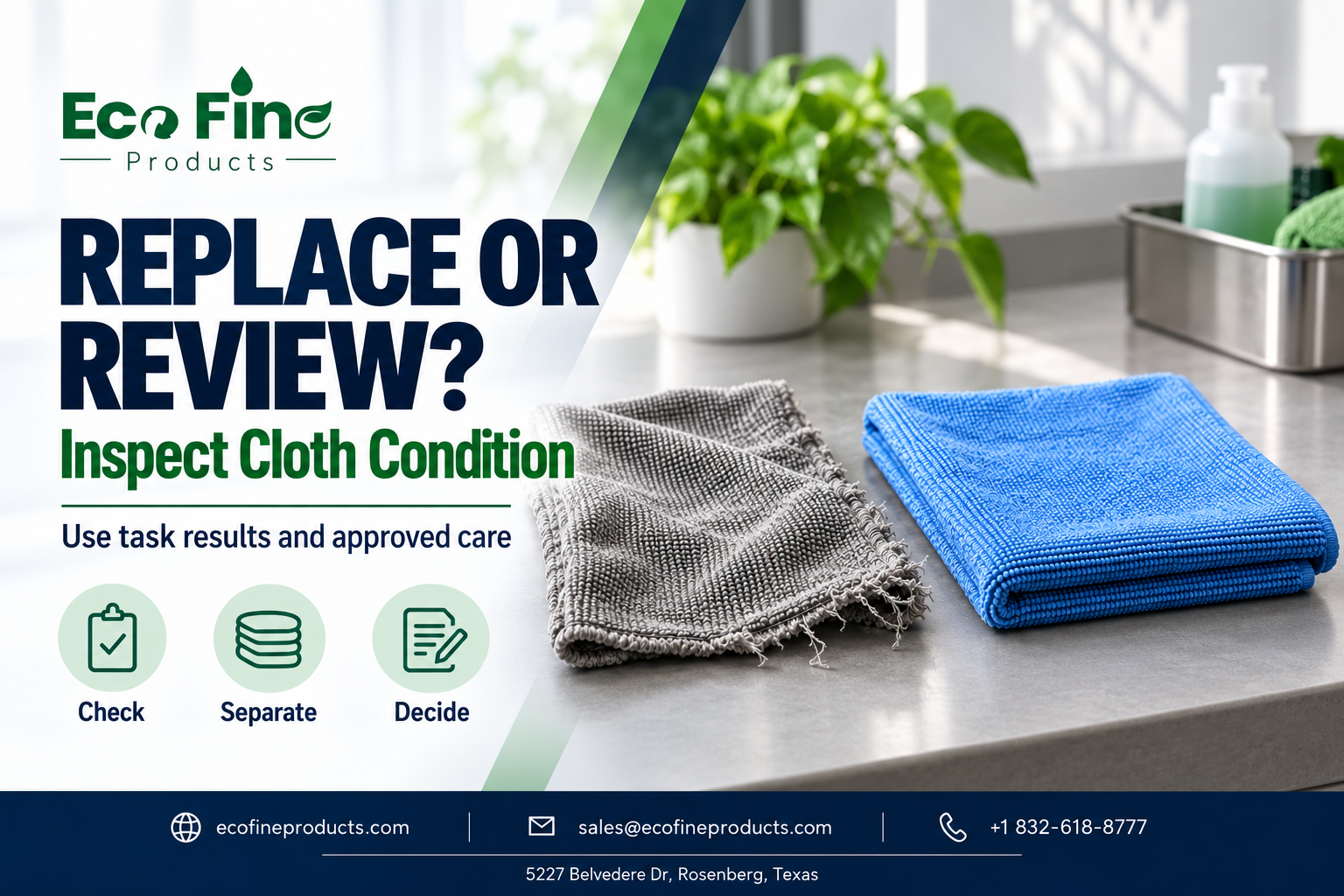
Replace microfiber cloths when they no longer meet the requirements of their assigned task, cannot be restored through approved care, or show damage or contamination that makes continued use inappropriate. Judge the actual item and its history. A universal replacement date or wash count cannot describe every product, surface, and cleaning operation.
For commercial buyers, a useful retirement policy avoids two expensive habits: discarding sound cloths because they look older, and keeping unsuitable cloths because they remain in one piece. The policy should explain what operators check, what supervisors investigate, and when purchasing needs to replenish the stock. Clear decisions are easier to apply across shifts and locations.
Define what a serviceable cloth must do
Start with the approved task. A finishing cloth may need to leave an acceptable visible surface without repeated polishing. A general wiping cloth may have different requirements for handling and soil removal. Establish the expected outcome without inventing performance claims. A cloth should be assessed against its intended work rather than an unrelated demonstration.
Record its identity, permitted care process, and assigned use. Review the microfiber cloth product categories when separating formats. If several items look similar, use storage labels or another suitable identification method so staff do not confuse a finishing cloth with a general-purpose or scrubbing product.
Appearance is evidence, but not the entire decision
A faded color, visible stain, or changed feel can justify inspection. It does not automatically establish that the cloth is dirty, safe, unsafe, or ineffective. Assess the relevant facility requirements and the results after approved care. If fading makes a designated color ambiguous, identification itself becomes a reason to remove the cloth from that role.
Do not use smell alone as proof of cleanliness. A fragrance may come from laundry products, while the absence of odor does not establish suitability. Follow the facility’s processing and inspection procedure. Where contamination or specialized hygiene requirements are involved, obtain the responsible professional’s direction instead of creating an informal reuse rule.
Separate process failure from cloth failure
When many cloths begin performing poorly at once, investigate the common workflow. A changed cleaner, laundry product, rinse process, or storage container may affect an entire group. Replacing every cloth without addressing that shared variable can reproduce the problem in the new stock. Keep the affected group identifiable while the cause is checked.
Compare a known-serviceable cloth using the same permitted procedure. If both leave the same film, examine the surface and cleaning process. If only the questioned item fails, inspect its condition and history more closely. A controlled comparison supports a decision but does not establish a laboratory rating or guarantee future performance.
Use a consistent inspection pathway

| Observation | First response | Possible final decision |
|---|---|---|
| Loose seam or torn edge | Inspect extent and task suitability | Retire if integrity is unacceptable |
| Persistent streaking | Compare process and approved care | Restore, reassign if permitted, or retire |
| Embedded hard debris | Isolate; review safe removal and surface risk | Retire when suitability cannot be established |
| Unclear color identity | Check the designated workflow | Remove from color-dependent assignment |
| Unknown contamination | Hold separately and seek applicable procedure | Process or dispose of as directed |
| Unacceptable post-laundry result | Review care compliance and repeat assessment | Retire if the requirement remains unmet |
The table describes an operating pathway, not permission to recover every contaminated item. Disposal and processing requirements depend on what the cloth contacted and the rules governing the facility. Preserve those controls when adapting the policy to your own operation.
Look closely at physical damage
Inspect edges, seams, working faces, and any labels that affect the task. A loose edge can interfere with folding or handling even before the cloth separates completely. Record whether the damage is isolated or appears across a group. Similar defects in recently received items may warrant a supplier discussion rather than routine retirement alone.
Avoid unauthorized repairs that introduce a new surface-contact risk or obscure product identity. A repaired cloth may behave differently from the accepted item, especially on a sensitive finish. If repair is considered, define who approves it and how suitability is checked. In many ordinary operations, replacement is easier to control than an informal repair system.
Review care instructions before attempting recovery
Do not improvise stronger chemicals or excessive heat to rescue a poor-performing cloth. Obtain the applicable product instructions and confirm what the facility can safely process. Instructions from a different brand may explain general care concerns but cannot establish the limits of your specific item. Ask the supplier when required information is missing.
Unger’s microfiber care information highlights how unsuitable laundry chemistry can affect microfiber performance. This makes a laundry review sensible when cloths develop a widespread problem. It does not prove a damaged item can be restored or authorize a particular treatment for EcoFine products.
If approved reprocessing is appropriate, document the method and reassess the original task afterward. Do not return the cloth to service simply because it has completed another wash. The decision should depend on the relevant requirements and inspection outcome. Keep unresolved items outside the clean, ready-to-issue stock.
Reassignment requires an approved purpose
Some facilities may permit a serviceable cloth to move from a demanding finishing role to a different general task. Establish that permission explicitly. A lower appearance requirement does not eliminate contamination concerns or override hygiene-zone restrictions. Do not move used cloths between incompatible areas simply to delay disposal.
Label the new assignment and keep it separate from the original stock. Otherwise, a cloth rejected from finishing may return to the same trolley later. Review the color-coded cloth workflow against your written local procedure. Identification should make the approved role easier to follow, including for relief staff.
Record reasons so replacement purchases improve
Use a short retirement record with item identity, approximate service history where known, observed problem, decision, and date. Do not invent missing wash counts. Group reasons into useful categories such as damage, failed task result, lost identification, or contamination. A few consistent categories are more actionable than long unstructured comments.
Review trends by product and location. Frequent losses may point to collection or storage problems, while repeated seam damage may justify investigating handling or the supplied batch. A decline in useful service can also follow a route change. Ask what changed before assuming the product specification alone caused the result.
A shift-level decision routine
- Check the cloth’s identity and visible condition before issue.
- Remove questionable items from ready stock and record the reason.
- Let the assigned supervisor decide whether investigation is appropriate.
- Return only items that meet the approved requirements.
- Use retirement and loss records to update replenishment quantities.
Connect the record to purchasing rather than treating it as a housekeeping form. When an operation sees sustained retirement above expectations, review the workload, care process, and replacement plan together. Discuss relevant options through EcoFine’s commercial supply information before making an unsupported durability assumption about a different cloth.
Frequently asked questions
How many washes should microfiber cloths last? Use verified information for the specific product and care process. Actual service varies with task, contamination, handling, and processing. Do not transfer another manufacturer’s published wash count to a different item or treat a short workplace trial as a lifetime guarantee.
Does a permanent stain mean a cloth must be discarded? A stain alone does not answer every suitability question. Assess applicable hygiene requirements, identification, surface performance, and the approved care outcome. Where the facility’s procedure requires removal, follow it even if the cloth still appears physically intact.
Can a faded cloth remain in a color-coded system? Only if its assignment remains clear under the facility’s approved procedure. An ambiguous color can create a selection error. Remove it from the color-dependent role when staff cannot reliably identify the intended use.
Should embedded grit be brushed out? Do not assume visible removal establishes suitability for a sensitive surface. Isolate the item and follow applicable product and facility guidance. If the risk cannot be resolved through an approved process, retire it from the affected use.
Can poor-performing cloths be used elsewhere? Reassignment requires an appropriate task and explicit facility permission. It must not cross prohibited hygiene boundaries or ignore contamination history. Clearly identify reassigned stock so it cannot return accidentally to the original role.
What if new cloths fail immediately? Check the delivered specification, applicable preparation instructions, and the cleaning method. Preserve examples and batch information where available. Share specific observations with the supplier instead of processing or distributing the whole shipment before the discrepancy is understood.
Should replacement be scheduled or condition-based? Follow any mandatory facility requirements, then use condition and task results to guide ordinary decisions. Scheduled review can help identify problems, but a calendar alone does not prove continued suitability. Remove an unacceptable item whenever it is found.
How does retirement data help purchasing? It shows which products disappear from service and why. This supports better stock planning, supplier questions, and process correction. It also separates wear-related replacement from loss, making a quotation comparison more meaningful for the actual operation.
Replace with a reason, then check the result
A defensible retirement policy connects product condition to the assigned task and approved process. Record the decision, preserve clean-stock separation, and use trends to improve the next purchase. Contact EcoFine Products for replacement-cloth specifications with your application, care requirements, and observed retirement reasons.